In shortWhale watching at Cabo San Lucas is authorized from 15 December 2026 under the federal notice signed on 22 October 2026, and runs to 30 April 2027. Trips sold earlier in the month are marine wildlife outings around the headland. Numbers build through the second half of December, while the peak falls between January and March.
15 December 2026season opens at the cape
30 April 2027last authorized day
22.1 Cmean December air temperature
17:37sunset on 15 December
When does whale season start in Cabo
Opening day comes from paperwork rather than from the water. SEMARNAT signed the 2026-2027 notice in Mexico City on 22 October 2026, and that document switches the activity on in the Cabo San Lucas area on 15 December 2026 and off on 30 April 2027. The December date does not shift depending on where in the municipality you book: the Flora and Fauna Protection Area at the cape, San Jose del Cabo inside it, and Cabo Pulmo National Park all start on the same day.
Older calendars and general travel pages often say the season begins in early December, which is how the official Los Cabos tourism board describes it: early December to mid-April, varying year to year, with the peak from January to March. Treat that as a description of the pattern. The enforceable date for this season is the 15th, and it is reset by a new notice every autumn, so check the current one if you are planning a December trip a year ahead.
The first two weeks of the month
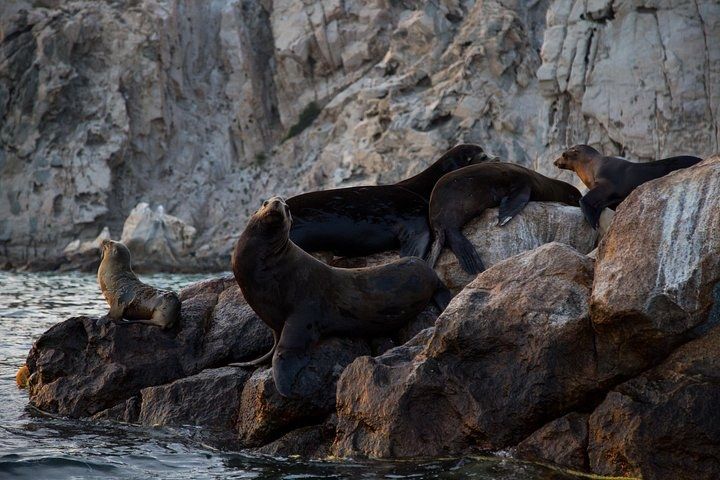
Between the 1st and the 14th there is no whale-watching product on sale at the cape, because the authorization has not started. What the marina offices run instead in that window is marine wildlife sightseeing: a couple of hours along the headland past the Arch, Lovers Beach and Pelican Rock. If your dates fall between 1 and 14 December, book one of those outings for the coastline and price it as sightseeing, not as a whale trip, and let any blow you happen to see be a bonus rather than the reason you paid.
There is a second reason the pre-opening loop is not a whale search. The 2026-2027 notice draws two closures inside the protected-area polygon. One covers its northern part inside the port precinct, taking in a 2-kilometre zone around the Arch of Cabo San Lucas; the other is a 1-kilometre band along the eastern boundary, running seaward from Punta Ballenas. That is most of the water a scenic loop covers. Once the season opens, the boats go past it and keep going.
If your stay straddles the date, move the boat day to the 15th or later. Three days of waiting buys you an authorized whale trip instead of a coastal cruise.
| Dates | What boats may run | What to expect |
|---|
| 1 to 14 December 2026 | Marine wildlife sightseeing along the headland | Headland scenery past the Arch, Lovers Beach and Pelican Rock; a whale is luck |
|---|
| 15 December 2026 | First authorized whale-watching departures | The season's shortest daylight; the sun is down by 17:37 |
|---|
| 16 to 31 December 2026 | Whale watching in the authorized part of the polygon | Numbers building through the holidays, still ahead of the peak |
|---|
| January to March 2027 | Whale watching | Peak of the season, with calves in the wintering grounds |
|---|
Catamaran with a hydrophone
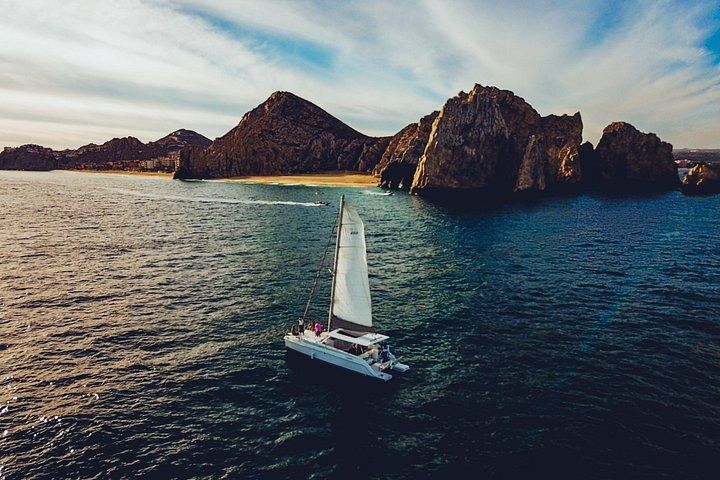
For a December trip booked from the 15th onward, this 2.5-hour catamaran gives you shade, drinks and the hydrophone that lets the crew cut the engine while a whale sings, from $129 and rated 4.9 ★ (2294 reviews).
★ 4.9/5 · 2,294 reviews
Cabo whale watching in December once the season opens
From the 15th the format is a 2-hour or 2.5-hour departure from the marina, working the authorized water that begins beyond the closed circle at the cape. The protected area is compact at 3,996.04 hectares, of which 3,787.99 are marine, so a good deal of the trip is spent holding position and reading the surface. The numbers that govern what you see are fixed by NOM-131-SEMARNAT-2010: a boat under 10 metres keeps at least 60 metres off a humpback, a medium or large vessel at least 80 metres, four boats maximum stay with one whale or group, observation stops at 30 minutes, boats queueing hold 240 metres, and speed stays under 5 knots inside the area with about 2 knots on entry.
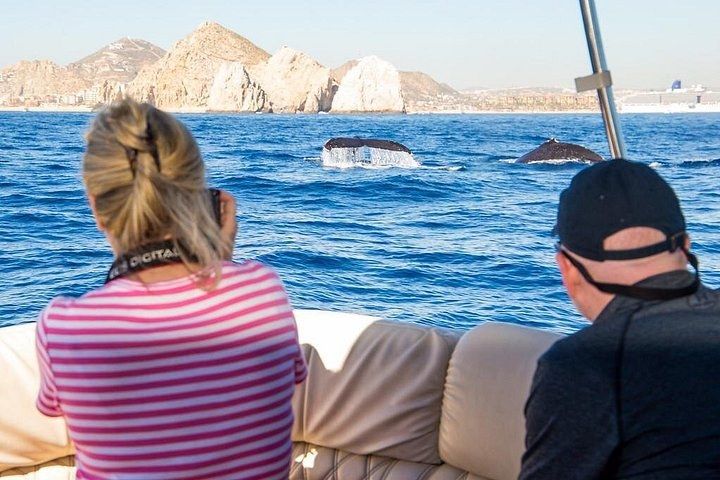
A sighting starts as a bushy blow 10 to 16 feet high, then a back, then on a deeper dive a tail lifted vertical with flukes up to 18 feet across. In December the realistic list of animals is short: humpbacks and gray whales account for nearly everything the boats find, while blue, fin and orca turn up far less often. If the boat carries a hydrophone, the crew is allowed to shut the engine down while it is in use, which is the only situation in which you hear a male's song instead of an idling motor. A complete song lasts 7 to 30 minutes and singers stay more or less in one place while they perform.
Calf expectations are worth setting honestly for the opening weeks. Gestation runs 11 months, a newborn humpback measures about 13 to 16 feet, and it stays with its mother for up to a year, so pairs only become the routine sighting in the wintering grounds as the January to March peak gets under way. On a trip on the 16th or 17th, plan on adults moving through and treat a mother with a calf alongside as luck.
Across the second half of the month the water in front of the cape keeps filling as more animals complete the migration from the northern feeding grounds, a run of roughly 5,000 miles for some populations. A Christmas-week departure therefore sits closer to peak conditions than one on opening day, though the January to March peak is still ahead of it. Book holiday-week dates early and schedule the boat day for the first half of your stay, which leaves a second morning free later in the week.
Air, wind and light at the cape
December averages 22.1 C in air temperature at the cape, and the official tourism board describes December to February as hovering around a comfortable 75 F. On a moving deck with a north-northwest breeze it feels cooler than that, so take layers and a windproof outer rather than a single shirt.
Wind in December averages 3.9 m/s at 10 metres and comes from 341 degrees on average, with winter peak speeds reaching roughly 10 to 12 m/s. That is among the quietest air of the whole window, which matters more than engine size when the boat has to sit 60 to 80 metres off an animal and work the surface for a blow.
Daylight is the real December constraint. On the 15th the sun rises at 06:53 and sets at 17:37, with civil twilight running 06:28 to 18:02, the shortest stretch of the authorized season. Take the first morning slot: the tourism board's own guidance is that early departures bring calmer seas and softer light. Leave the late and sunset departures for February onward, when there is still something in the sky after 18:00.
- Layers plus a windproof top for air around 22.1 C and a north-northwest breeze over the deck
- A hat and sunscreen that will hold up for the full 2 to 2.5 hours on an open deck, much of it under way
- Some reach on the camera: roughly 60 to 80 metres is as close as a permitted boat gets, depending on the size of the vessel
- Shutter Priority at 1/1000 second, ISO on Auto, a high burst rate set before you leave the dock, and the low December sun behind your shoulder
- Motion sickness remedy taken before boarding, with a horizon reference and a seat away from the bow once aboard
Book for December or wait for the peak
With flexible dates, aim at mid-January to the end of February. You get the January to March peak, mother-and-calf pairs as the normal sighting, and mean wind still at its seasonal low. With fixed December dates, the trip is worth doing from the 15th onward, booked in the morning, on a boat that carries a hydrophone.
Two of the tours on this site fit the opening weeks well. Cabo San Lucas Luxury Catamaran Whale Watching lasts 2.5 hours, starts from $129 and sits at 4.9 ★ (2294 reviews); the hydrophone on board is what buys you the song, and snacks and alcoholic beverages come with it. Its round-trip transportation fee is paid at check-in, and the dock entrance fee is not included. The 2.5-hour Small-Group Whale Watch with Marine Biologist in Cabo San Lucas runs from $109 and is rated 4.9 ★ (1256 reviews), with a hydrophone, a restroom on board and the guide's photos offered to guests at no extra charge; transportation and gratuities are not included, and single-use plastic bottles are no longer provided.
Pick the catamaran if anyone in the group wants shade, drinks and a steadier platform. Pick the small-group biologist boat if you want fewer people around the hydrophone and a restroom for a 2.5-hour trip. Both operate inside the 15 December to 30 April window, so the only question left for a December traveller is which side of the 15th your boat day falls on.
Questions people ask
Is Cabo whale watching open at Christmas?
Yes. The authorized season for 2026-2027 opens on 15 December 2026, so Christmas and New Year dates fall inside the legal window. Holiday weeks are later in the ramp up than opening day but still ahead of the January to March peak. Dock entrance fees and hotel transport are listed as not included on several of the tours here, so allow for them separately.
Does the 15 December start date change from year to year?
It can. The season and its restricted zones are set by a SEMARNAT notice issued each year, and the one covering 2026-2027 was signed in Mexico City on 22 October 2026. For this season the Cabo San Lucas area is authorized from 15 December 2026 to 30 April 2027. If you are planning a December trip for a later year, look up the current notice rather than assuming the same dates.
How do I tell an authorized whale-watching boat from one that is not?
Two things are required before a boat can take you out in December: a SEMARNAT authorization for non-extractive use of wildlife, and an official identifying marker displayed where passengers can see it. In practice that means a whale-watching flag issued for the season with a number in the bottom right corner identifying the year, flown throughout the trip. The pre-departure briefing on passenger behaviour is also a legal requirement, along with visible signage of the rules. Lacking the permit, a boat is held to roughly 800 feet from a whale, far outside the distance it would be selling you.
Is December a difficult month for anyone prone to seasickness?
December wind averages 3.9 m/s at 10 metres, among the lightest of the season, and the official advice is that early departures bring the calmer water, so the first morning slot is the one to take. The CDC's guidance is practical: keep a visual horizon in sight, avoid the bow and other areas of maximum motion, limit head movements, skip reading, and avoid alcohol and smoking because both make symptoms worse. With children, the 7 to 12 age band is the most affected, susceptibility falls away after that, and under-twos usually feel nothing.
Read also