In shortJanuary to March is the peak of the Cabo season, inside a legal window that runs from 15 December 2026 to 30 April 2027 under the federal notice. In February, Cabo whale watching brings mothers with newborn calves and mean wind of 3.9 m/s at 10 metres; March averages 4.1 m/s. Permitted boats work from 60 to 80 metres, four at a time, 30 minutes per whale.
January to Marchpeak of the season
20.9 CFebruary mean air temperature
3.9 m/smean wind, January and February
60 to 80 mclosest permitted approach
Why the peak whale watching season in Cabo runs January to March
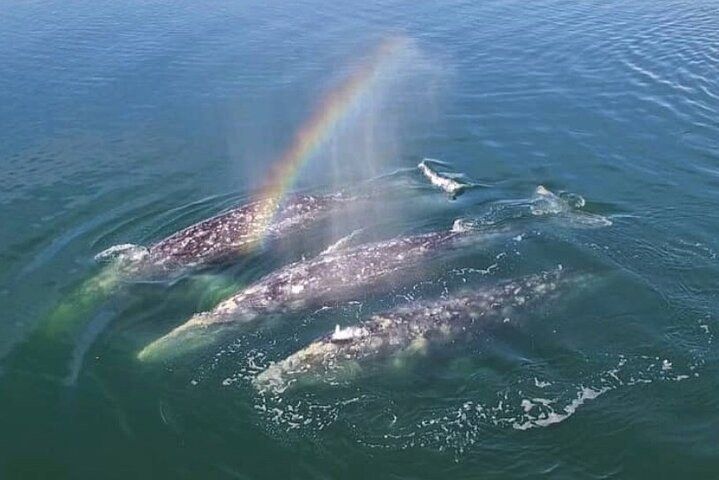
The peak of the season at the cape runs from January to March. Those three months sit inside a longer authorized period: the federal notice for 2026-2027 opens observation at Cabo San Lucas on 15 December 2026 and keeps it open to 30 April 2027, while the official Los Cabos tourism board frames the same thing loosely as early December to mid-April, shifting from year to year. What fills the peak weeks is humpback and gray whales; blue, fin and orca turn up far less often. Mexican waters hold at least nine whale species, and SEMARNAT classifies every one of them as a species at risk, which is why the busiest months are policed on exactly the same terms as the quiet ones.
Three things line up in these weeks. Newborns are in the water: an 11-month gestation puts calves of about 13 to 16 feet onto the wintering grounds, and they stay alongside the mother for up to a year. Male song is in the water, built from themes, phrases, units and subunits, with a complete song lasting 7 to 30 minutes. And the air is at its quietest: mean wind at 10 metres sits at 3.9 m/s in January and February before rising to 4.1 m/s in March, with winter peaks around 10 to 12 m/s.
Cabo whale watching February: calves, song and the flattest water
February is the month to book if your dates are flexible. Mean air temperature is 20.9 C, the coolest of the five authorized months, and the tourism board puts December to February around a comfortable 75 F. Wind averages 3.9 m/s out of 329 degrees. Sea temperature is the one number not to build a February plan on: the satellite value at the same point off the cape came out at 23.5 C on 15 February 2026 and 19.9 C on 15 February 2025, two readings for the same mid-month date in consecutive years. Light is already useful at the end of the day, with sunset at 18:16 on 15 February and civil twilight running to 18:39.
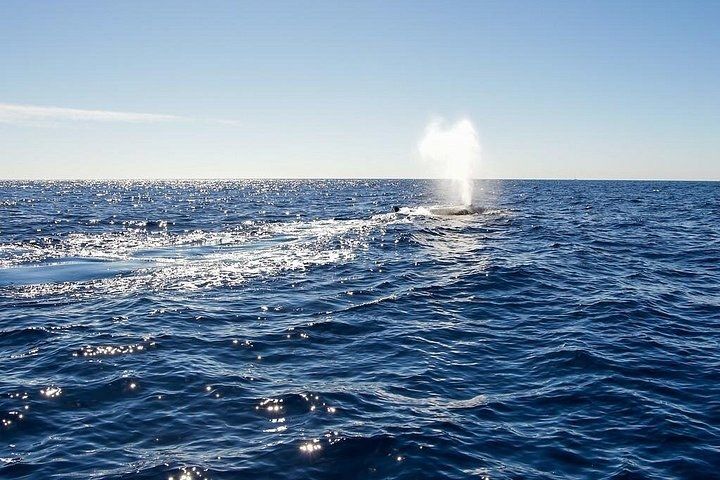
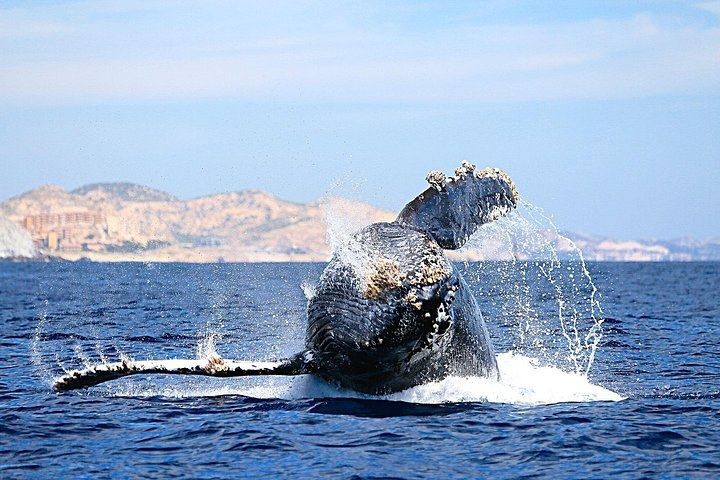
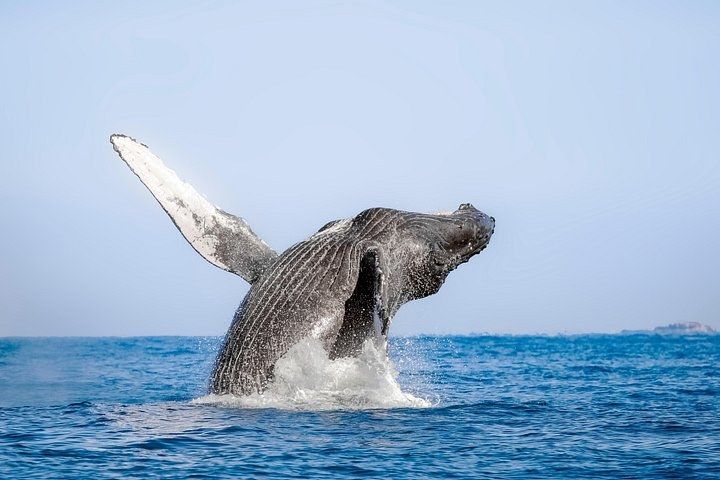
Mother and calf pairs are the sighting that defines these weeks, since a female produces a single calf every two to three years on average and the wintering grounds off the cape are where the newborns appear. Singers behave differently from travelling adults: they stay relatively stationary through the display, which is why a boat carrying a hydrophone can hold position and let you listen. Surface behaviour is the other reason February trips feel busy from the rail. A sighting starts as a bushy blow 10 to 16 feet high, and from a permitted boat the behaviours reported most often are breaching, spyhopping, lobtailing, pectoral slapping and logging quietly at the surface.
January, February and March month by month
January is already fully inside the peak, and the second half of the month is the point where calves stop being luck and start being normal. On 15 January the sun rises at 07:03 and sets at 17:56, with solar noon at 12:29, so a midday departure puts the sun high and hard over the water. Mean air temperature is 21.2 C and the wind holds at 3.9 m/s out of 340 degrees. Treat January as a full peak month rather than a shoulder one: departures fill the way they do in February, so fix your boat dates before you fly.
March keeps the whales and loses some of the water quality. Mean air temperature rises to 21.5 C, with the tourism board describing March and April as reaching the low 80s, and mean wind climbs to 4.1 m/s out of 315 degrees, which you feel as chop once the boat clears the lee of the point. Sea-surface temperature off the cape read 23.4 C on 15 March 2026. If you are planning a March trip, take the earliest slot you can get and treat the afternoon as your spare.
The gap between 3.9 and 4.1 m/s looks trivial written down. On the water it is the difference you notice, because the boat is holding 60 to 80 metres off the animal and most of a 2 or 2.5 hour trip goes on picking a blow out of the surface at that range.
| Month | Mean air temperature | Mean wind at 10 m | Mean wind direction |
|---|
| January | 21.2 C | 3.9 m/s | 340 degrees |
|---|
| February | 20.9 C | 3.9 m/s | 329 degrees |
|---|
| March | 21.5 C | 4.1 m/s | 315 degrees |
|---|
Small group, hydrophone, 2.5 hours
In the February and March weeks when song is in the water, this is the trip that can legally cut its engine to let you hear it, with a marine biologist on board and fewer people around the hydrophone.
★ 4.9/5 · 1,256 reviews
What a boat can and cannot do around a mother and calf
NOM-131-SEMARNAT-2010 sets two limits that shape every calf encounter in these months. A boat may not place itself between a mother and her calf, and it may not approach whales that are mating or giving birth. In practice a captain who has read the situation correctly will reposition or back off rather than hold a line through the pair, and a crew that runs between the two is in breach of the standard. When a pair is on the move, the only permitted line is a diagonal from the rear quarter, parallel to the course the whale is holding, and nothing head-on.
Engine handling is also written into the rule. While observing, a boat keeps the engine running in neutral when the whale is not moving, and may switch it off only to use a hydrophone to listen to whale song. That single clause is why hydrophone boats are a different trip rather than a boat with an extra gadget. Before departure the operator must brief passengers on how they are required to behave and display the rules on visible signage, so an unbriefed departure tells you something before you have even left the dock.
- At least 60 metres from a humpback for boats under 10 metres, at least 80 metres for medium or large vessels
- 240 metres for any boat waiting its turn
- No more than four boats around the same whale or group at one time
- 30 minutes maximum observation on the same whale or group
- Under 5 knots inside the observation area, about 2 knots on entering it
- No fishing, diving, swimming, water-skiing or parasailing during observation, and no sonar or echo sounders to locate whales
- No whale watching from a jet ski, kayak, canoe or paddle-powered inflatable, in any month of the season
- A SEMARNAT authorization, plus the season's whale-watching flag with the year number in the bottom right corner, flown throughout
Peak season means busier departures
Boat traffic is already written into the map. Excessive traffic is the stated reason two slices of the cape's protected area are shut under the 2026-2027 notice: the northern end of the polygon inside the port precinct, which takes in 2 kilometres around the Arch of Cabo San Lucas, and a 1-kilometre strip down the eastern boundary running seaward from Punta Ballenas. The water left to work is compact, 3,996.04 hectares in total with 3,787.99 of them marine. Put four boats maximum on one group, a 30-minute cap and a 240-metre holding distance on top of that, and peak-season trips include time spent queueing.
Book the boat day ahead of your arrival rather than at the marina, and take the first morning departure: the official tourism board's own advice is that early trips bring calmer seas and softer light. Keeping the afternoon clear is useful for a second reason, since the all-female-crew trip on this site states a whale warranty giving a second tour at no cost if no whales are found on the first, and a guarantee like that is only worth something if you still have days left.
For a high-activity day, trip style decides how much of it you actually register. Small-Group Whale Watch with Marine Biologist in Cabo San Lucas runs 2.5 hours from $109 and sits at 4.9 ★ (1256 reviews); a hydrophone and an onboard restroom come with it, and the guide's photos go to guests at no extra charge. Check in at Plaza Bonita in the Cabo San Lucas Marina, behind Starbucks if you arrive from the road and behind Nowhere Bar if you walk along the marina. The 2-hour Cabo Whale Watching: Female Crew, Guaranteed Sightings, Photos runs from 1,680 pesos, rated 5.0 ★ (2144 reviews), with biologist captains and guides and digital photos of the tour included, leaving from dock zero in front of the Breathless hotel. The Humpback Whale Watching Tour in Cabo San Lucas is 2.5 hours from $99, rated 4.9 ★ (1065 reviews), with a marine biologist guide, bottled water and marine park fees included, meeting inside the Tesoro Hotel at Local A-20 near dock M-O. Hotel transport is not included on the small-group or humpback trips; check each tour page for dock fees and gratuities.
Which month and which boat to pick
Mid-January to the end of February is the stretch to target if your dates move at all. You get the peak, calves in the water and the season's lowest mean wind at 3.9 m/s, and by mid-February there is still usable light at 18:16 if you want a late departure. March is a solid second choice and still inside the peak, with the earliest slot of the day doing more for you than any upgrade in boat size. Do not write off late April on the strength of operator calendars: for 2026-2027 the cape is authorized through 30 April 2027.
On the boat itself, default to the 2.5-hour small-group biologist trip at $109. The hydrophone is the deciding feature in these months, because it is the only lawful reason a crew may shut the engine down while a whale sings, and the restroom matters on a 2.5-hour run with children aboard. Choose the 2-hour all-female-crew boat from 1,680 pesos if photos and a stated sighting guarantee are what you want, and the $99 humpback trip if you prefer a straightforward biologist-led search with marine park fees already in the price.
- Mid-January to end of February: strongest balance of whales, calves and light wind
- March: still peak, mean wind 4.1 m/s, take the first morning slot
- Song and a quiet engine: the hydrophone boat
- Photos included and a second tour if no whales are found: the all-female-crew trip
- Marine park fees included and a marina meeting point: the $99 humpback trip
Questions people ask
Does the season end after March?
No. The peak runs January to March, but the 2026-2027 federal notice authorizes whale watching in the Cabo San Lucas area until 30 April 2027, and the same dates cover Cabo Pulmo National Park. A 15 April finish is still printed on operator calendars, so the last two authorized weeks read as shut while the notice keeps them open. The notice is reissued each year, so check the current one if you are planning far ahead.
Can I get in the water with a whale or a calf in February?
No, in February or in any other month: getting into the water with a whale is illegal at Cabo, and during whale observation fishing, diving, swimming, water-skiing and parasailing are all off. Orcas at La Ventana are the state's only lawful in-water cetacean encounter, under a Baja California Sur pilot scheme that caps the water at 24 boats a day; from Los Cabos it costs you at least six hours. Whale shark snorkelling is a separate La Paz activity with its own season from October through May.
Is seasickness worse on a March trip than a February one?
Mean wind rises from 3.9 m/s in February to 4.1 m/s in March, which is enough to put more chop under the boat once you leave the lee of the point. CDC advice is practical: keep a visual horizon reference, stay out of the bow where motion is greatest, avoid head movements and avoid reading or scanning, skip alcohol and smoking, and get fresh air on your face. Ages 7 to 12 are the most susceptible, with susceptibility falling away through adulthood, and under-twos are usually unaffected.
How do I check the boat is properly permitted at the busiest time of year?
Anyone offering whale watching must first hold a SEMARNAT authorization, and authorized vessels carry an official identifying marker in a visible place. In practice that is the whale-watching flag issued each season, with a number in the bottom right corner identifying the year, flown at all times while whale watching. A boat without a permit is held roughly 800 feet off a whale, far outside the 60 to 80 metres a permitted vessel works from.
What camera settings work for a breach from a peak-season boat?
Keep the sun behind you where the course allows, and set the camera before you leave the dock. The National Park Service setting for moving wildlife is Shutter Priority at 1/1000 second with ISO left on Auto, sharp without a tripod, together with a high burst rate. Take an early frame and keep shooting rather than waiting for one perfect moment, and bring some reach, because 60 to 80 metres is as close as the boat will be.
Read also