In shortFor a whale watching tour for kids in Cabo, book the 2.5-hour small-group biologist boat, from $109 and rated 4.9 ★ (1256 reviews), because it lists a restroom on board and carries a hydrophone. A child under five will not be allowed on the fast inflatable boats, which also turn away pregnant guests and anyone with heart, back or neck problems. Take a morning departure.
5Minimum age, fast boats
2 to 2.5 hTime on the water
60 to 80 mLegal distance from whales
7 to 12Peak seasickness ages
Which whale watching tour for kids in Cabo works best
Book the small-group biologist boat if you are bringing children. It runs 2.5 hours, from $109, rated 4.9 ★ (1256 reviews), and it is the only trip on this site with a restroom listed on board, which usually decides whether a six-year-old lasts the whole departure. There is a hydrophone for whale song, and the guide's photos go to guests at no extra charge, so nobody spends two hours holding a phone over the rail. With children in tow you want check-in easy to find: Plaza Bonita, inside the Cabo San Lucas Marina, behind Starbucks if you arrive by road and behind Nowhere Bar if you walk up from the marina side. Transportation and gratuities are not included.
With a toddler along, or grandparents on the same booking, go shorter. The group tour from San Jose del Cabo runs 2 hours, from $99, rated 5.0 ★ (271 reviews), with water and cookies ready on board, hydrophone listening and tour pictures at no extra charge. Two meeting slots are usual, 8:15 AM and 11:30 AM, which is what makes this trip easy to fit either side of a nap; both can shift, so open the confirmation email the evening before. The office is at Puerto Los Cabos Marina and most local hotels are 10 to 15 minutes away by taxi or ride-hail; private transportation is not included.
The 2.5-hour luxury catamaran, from $129 and rated 4.9 ★ (2294 reviews), earns its price when the adults want food and drink on board and you would rather have a catamaran deck under you than a small boat. Snacks and alcoholic beverages are included, the legal drinking age in Mexico is 18, and there is a hydrophone. Two charges land at the dock instead of in the ticket price: the round-trip transportation fee, settled at check-in, and the dock entrance fee.
| Tour | Duration | From | Rating | Useful with children |
|---|
| Small-Group Whale Watch with Marine Biologist | 2.5 h | $109 | 4.9 ★ (1256) | Restroom on board, hydrophone, guide's photos at no extra charge |
|---|
| Whale Watching Group Tour in San Jose del Cabo | 2 h | $99 | 5.0 ★ (271) | Shortest option, water and cookies on board, hydrophone, tour pictures at no extra charge |
|---|
| Cabo San Lucas Luxury Catamaran Whale Watching | 2.5 h | $129 | 4.9 ★ (2294) | Snacks and hydrophone on board, catamaran format |
|---|
The minimum age for whale watching in Cabo, and who cannot board
Five is the age limit you meet on the fast boats. One licensed Cabo operator sets a minimum of five on its Zodiac trip and also excludes pregnant guests and people with heart, back or neck problems. The limits follow the hull: the rigid-inflatable speedboat format in Los Cabos runs 2 to 2.5 hours with hydrophones and no restroom on board, while the catamaran format runs 2.5 hours with shade. Anyone under five, and anyone who should not take impacts through the spine, goes on the catamaran.
Minimum ages are set by each operator rather than by the federal rules, so get the age limit confirmed in writing before you pay if your child is four or younger. The law does regulate the craft itself: jet skis, kayaks, canoes and paddle-powered inflatables may not be used for whale watching at all, so an inflatable sold as a whale-watching trip is a powered, authorized boat.
Age cuts both ways in a family. The CDC puts the peak of motion-sickness susceptibility between ages 7 and 12, declining through adulthood, and says children under two are usually unaffected. Sleep deprivation makes symptoms worse, which is the real argument for an early night before a morning departure instead of a late dinner on the marina.
The family format: small group, restroom, hydrophone
Of the tours on this site, this 2.5-hour small-group trip with a marine biologist is the one that lists a restroom on board alongside the hydrophone, from $109 and rated 4.9 ★ (1256 reviews).
★ 4.9/5 · 1,256 reviews
The briefing before the boat leaves the dock
At the start of every trip the operator has to brief passengers on required behaviour, and the rules have to be displayed on visible signage. With children aboard, that briefing is the moment to get them listening: almost everything that will frustrate them later is explained in it.
The distances come from NOM-131-SEMARNAT-2010. Tell a child before boarding that the whale will not come to the boat: a permitted vessel under 10 metres has to hold 60 metres or more off a humpback, and a medium or large boat 80 metres. The clock and the queue are regulated too, which is what the waiting is about: four boats at most around the same whale or group, 30 minutes before that group is left alone, 240 metres for the boats awaiting their turn, under 5 knots inside the observation area and about 2 knots on the way in. When the whale is moving, the captain comes in on a diagonal from its rear quarter, running parallel to its course, so the bow never points straight at the animal.
Two rules are worth repeating to a child before boarding. The engine stays running in neutral while a whale sits at the surface and may be switched off only to use a hydrophone, so a quiet deck is what buys you the song. A boat also may not place itself between a mother and her calf, or approach whales that are mating or giving birth, which is why a captain sometimes pulls away from the animal everyone is pointing at.
Children can check the paperwork from the deck. A SEMARNAT authorization is required of anyone offering whale watching, an authorized boat has to carry an official identifying marker somewhere visible, and SEMARNAT hands each authorized company a new flag every season, numbered for the year in the bottom right corner and flown the whole time whales are being watched. If nobody briefs you before departure, the trip is already outside the rules.
How long you are on the water, and where naps fit
Trips run 2 or 2.5 hours and nobody turns back early once you are out. Add check-in, the walk along the marina and the wait at the dock, and a 2-hour departure eats a half-morning, so a nap tends to move rather than disappear.
Take the first morning slot. The official Los Cabos tourism board advises that early tours bring calmer seas and softer light, and calm water counts for more with children on board, because the boat spends most of the trip holding position and reading the surface for the next blow. The San Jose del Cabo meeting times, generally 8:15 AM or 11:30 AM, sit either side of a midday sleep; they can change, so check the day before.
Leave late-afternoon and sunset departures to the adults. The sun sets at 17:56 on 15 January and at 18:16 on 15 February, so an evening trip finishes in fading light and lands on top of dinner and bedtime.
The dates are fixed by federal notice: whale watching in the Cabo San Lucas area, San Jose del Cabo included, is authorized from 15 December 2026 to 30 April 2027, with the peak between January and March. If your dates are still open, put the family trip between mid-January and the end of February, when calves are in the wintering grounds and mean wind at 10 metres sits near 3.9 m/s.
Keeping children watching for two and a half hours
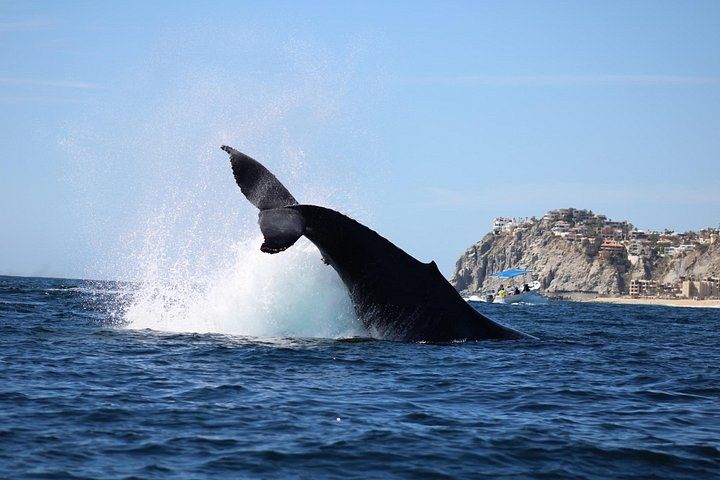
Children switch off when nothing happens, so give them something to count. A humpback's blow is bushy and 10 to 16 feet high and it is the first thing anyone spots, so whoever calls it first takes the point. On a deeper dive the whale lifts its tail to vertical and the flukes run up to 18 feet across, which makes fluke-ups the second tally of the trip.
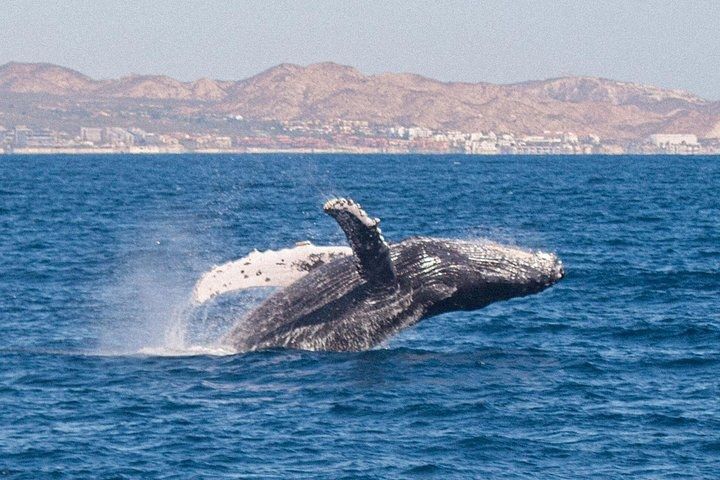
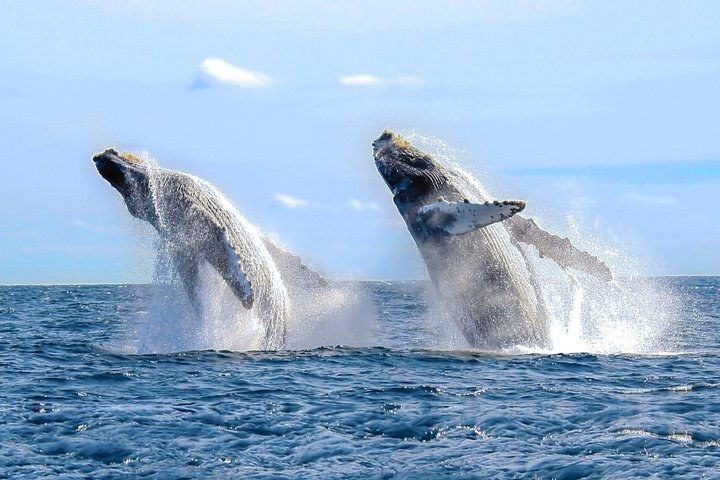
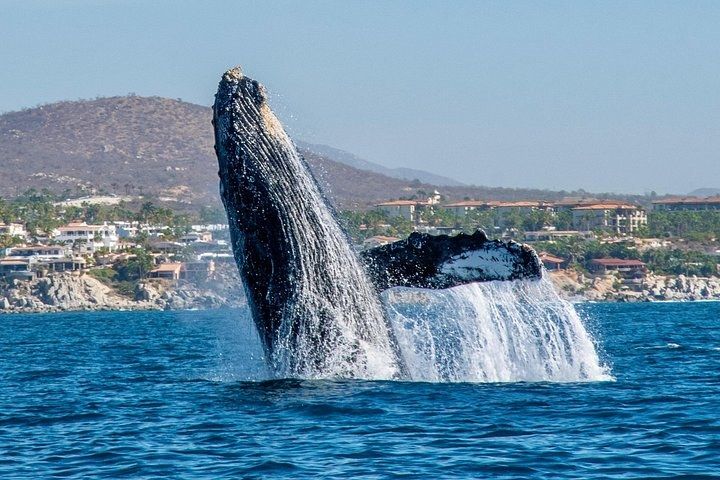
NOAA's list of the behaviours seen most often from whale-watching boats gives you a bingo card without printing one: breaching, spyhopping, lobtailing, which is slapping the surface with the tail, pectoral slapping, and logging, which is lying quietly at the surface.
The hydrophone is the part they remember. A complete humpback song lasts 7 to 30 minutes, built from themes and phrases that repeat before the whale moves on, singers stay more or less in one spot while they perform, and the songs change from year to year. The crew may only shut the engine off while the hydrophone is in use, so talking on deck is what ruins the listening.
Scale holds attention better than rules do. A grown humpback runs to about 60 feet and about 40 tons, females the bigger of the two sexes, and a life span of about 80 to 90 years means the animal off the bow can be older than anyone in your family. A newborn measures 13 to 16 feet after an 11-month gestation and stays with its mother for up to a year, so a pair at the surface in February is usually a mother with a calf born this winter.
Eyes on the horizon do two jobs. The CDC lists a visual horizon reference as something shown to give some protection against motion sickness, and a child scanning the water stays off a screen, since reading and visual scanning are on the CDC's list of things to avoid.
What to get ready before you leave the hotel
Pack for mild air and a steady breeze over the deck. Mean monthly air temperature at the cape runs from 20.9 C in February to 22.2 C in April, and the tourism board describes December to February as around a comfortable 75 F, rising to the low 80s in March and April. Wind at 10 metres averages 3.9 m/s in December, January and February, 4.1 m/s in March and 4.3 m/s in April, blowing from the north-northwest, which is enough to chill a damp child on an open deck.
- Layers for each child plus a windproof outer layer, because the breeze over the deck holds up even on a calm morning.
- Hats that stay on in the breeze, and enough sunscreen for every child to cover the whole 2 to 2.5 hours of open deck.
- A refillable bottle: single-use plastic bottles are no longer provided on the small-group biologist boat.
- Your own snacks if the trip you booked lists none; the San Jose del Cabo tour has water and cookies on board and the catamaran includes snacks.
- A seasickness plan: an early night, seats away from the bow since that is an area of maximum motion, posture aligned with the boat's movement, no reading, and fresh air on the face at the first complaint.
- Written confirmation of the minimum age if anyone in the group is under five, plus a check with the operator on child-size life jackets when you book.
- Money ready at check-in for what the ticket leaves out: the dock entrance fee, and on the catamaran the round-trip transportation fee.
- Nothing to drink for the adults before boarding, since the CDC notes alcohol and smoking both increase motion sickness.
Questions people ask
Can children get in the water with the whales?
No. Nobody of any age goes in: during whale observation, fishing, diving, swimming, water-skiing and parasailing are prohibited, and swimming with whales is against the law at Cabo. Baja California Sur allows one in-water cetacean activity, with orcas at La Ventana, under a pilot scheme limited to 24 boats a day; from Los Cabos it is a six-hour commitment at minimum, which is more day than most small children have in them.
What do we do if a child starts feeling sick on board?
Get them to a visual horizon reference, away from the bow, and have them keep their head still, which is also why lying down helps. The CDC also lists fresh air on the face, music and pleasant scents as useful, and notes that increased sensitivity to smells is itself a symptom. Habituation is the most effective countermeasure of all, so a second boat day usually goes easier than the first.
Will the boat stop at the Arch so the children can see it?
The water a child would expect the whales to be in is closed to whale watching: the northern part of the protected-area polygon inside the port precinct, including 2 kilometres around the Arch of Cabo San Lucas, plus a 1-kilometre strip along the eastern boundary running seaward from Punta Ballenas. Cruises that take in the Arch pass it as scenery on the way through. The whales are worked further out, so do not pay extra for a promise of whales at El Arco.
Are we guaranteed to see a whale with the children?
No official sighting statistics are published for Cabo San Lucas, and the success percentages in advertising are operator claims. The solid ground is this: Mexican waters hold at least nine whale species and SEMARNAT classifies every one of them as at risk, while the animals a family tends to see off Los Cabos are humpbacks and gray whales, with blue, fin and orca sightings much rarer. Book inside the January to March peak, early in your stay, for the best odds and room to try again.
Read also