In shortFebruary sits inside the January to March peak of the Cabo whale season, authorized this season from 15 December 2026 to 30 April 2027, so open the week with a 2.5-hour humpback trip from the marina. The other days take Land's End by boat, a corridor snorkel bay, Cabo Pulmo, Todos Santos, the sierra behind the towns and a La Paz whale shark day.
15 Dec – 30 Aprauthorized season 2026-2027
January to Marchpeak of the season
20.9 CFebruary mean air temperature
from $992.5-hour humpback trip
Book the whale boat first, then build the week around it
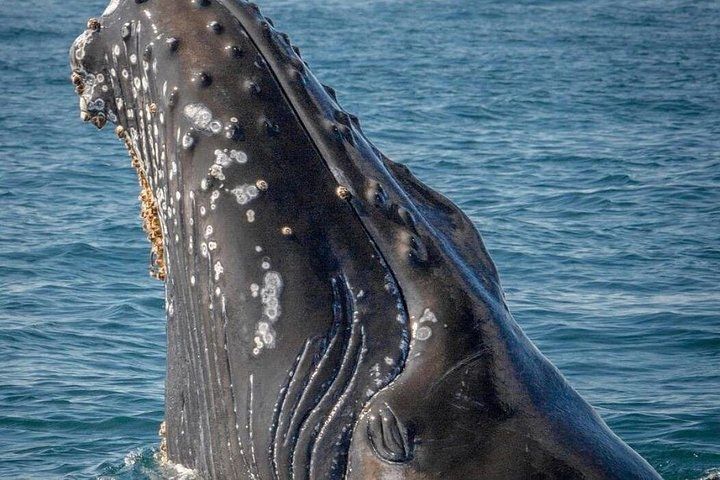
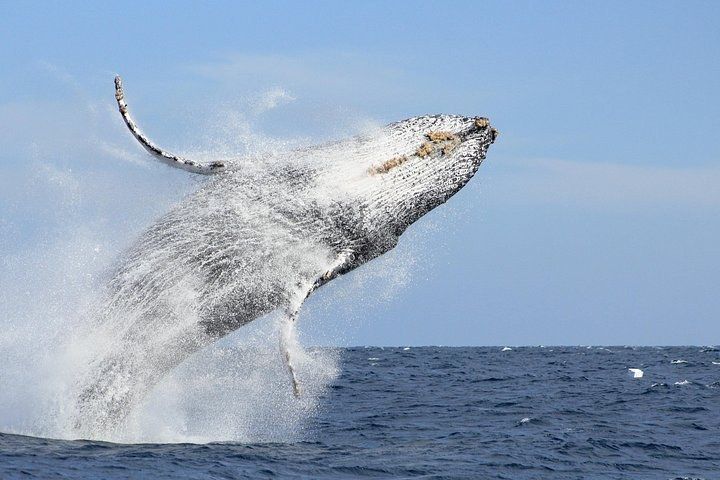
The whale trip is the fixed point of a February week, and it belongs on your first or second full morning. Mexico's federal notice for this season authorizes whale watching in the Cabo San Lucas area from 15 December 2026 to 30 April 2027, and the peak of that window runs January to March, which leaves February in the thick of it. What a February boat finds is humpbacks and gray whales; blue, fin and orca sightings are rare enough that no itinerary should be planned around them.
Calves are part of the February picture. A humpback calf measures roughly 13 to 16 feet at birth, arrives after eleven months of gestation and stays close to its mother for up to a year, and females produce one calf every two to three years on average, so mother-and-calf pairs turn up in the wintering grounds this month.
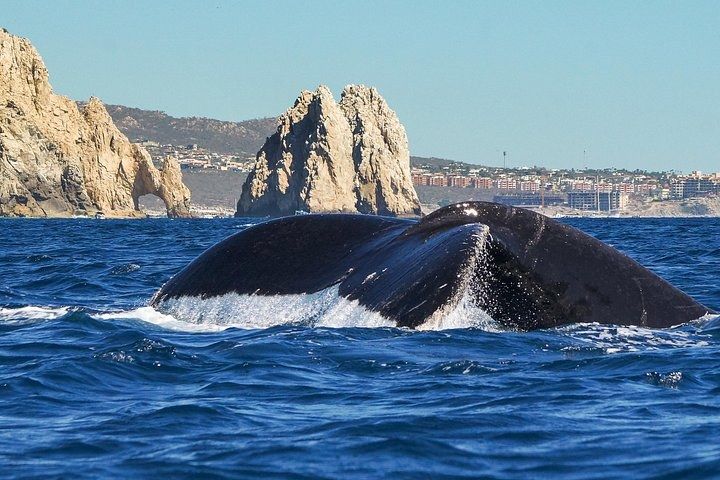
A cape departure runs 2 to 2.5 hours out of the Cabo San Lucas marina and works the water of the Área de Protección de Flora y Fauna Cabo San Lucas, 3,996.04 hectares with 3,787.99 of them marine. The whales sit further out than the Arch. The notice in force for your February dates shuts whale watching out of the polygon's northern end inside the port precinct, including a 2-kilometre circle drawn around the Arch of Cabo San Lucas, and out of a 1-kilometre band along the eastern boundary running seaward from Punta Ballenas, in both cases because of the volume of boat traffic there. Land's End goes past as scenery and the captain keeps going.
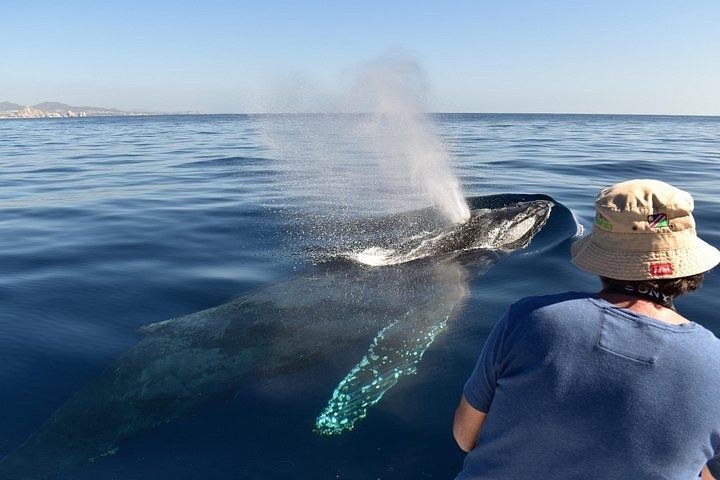
Take the earliest departure offered. The official Los Cabos tourism board advises that early trips find calmer seas and softer light, and February mean wind at 10 metres is 3.9 m/s, level with December and January as the lightest of the season. Calm water matters because a permitted boat holds roughly 60 to 80 metres off the animal depending on hull size, and much of the trip goes on reading the surface for a bushy blow 10 to 16 feet high.
Reserve the boat day before you fly. Demand in February is the highest of the season, and the rules cap what a crowd can do on the water: four boats maximum around the same whale or group, 30 minutes maximum with that group, 240 metres back while you wait your turn, under 5 knots inside the observation area and about 2 knots on entry. Morning slots go first.
The anchor of a February week
A peak-season morning is what this 2.5-hour trip is built for: from $99, rated 4.9 ★ (1065 reviews), a marine biologist on board, bottled water and marine park fees included. You check in at the Tesoro Hotel, Local A-20, on the Cabo San Lucas marina.
★ 4.9/5 · 1,065 reviews
What to do in Cabo during whale season, beyond the boat day
Everything else splits into water days near the towns, two long road days and one full day up the coast. Spread them so you are not driving on consecutive mornings, and leave one afternoon unbooked as a spare slot for the sea.
Cabo Pulmo National Park holds you to its own rules, and good operators say so before you get in the water. One guide is assigned per ten visitors, life jackets are compulsory for guests and guides in the reef zones, daytime snorkelling is limited to eight users per instructor, and you keep a minimum of 2.5 metres from rock and coral formations. Touching, standing on, treading on, holding onto or dragging equipment over the reef is prohibited, gloves are banned except on permitted night dives, and boats hold 4 knots with no wake within 200 metres of mooring buoys and inside swimming or diving zones. Whale watching inside the park is authorized for the same 15 December 2026 to 30 April 2027 dates, with a 3.5-kilometre coastal strip closed to whale-watching boats.
Getting along the corridor without a car is straightforward. For the day trips in this list the Ruta del Desierto urban bus links the main points between San Jose del Cabo and Cabo San Lucas, stopping on the highway at major hotels, and the tourism board puts the ride at approximately one hour and the fare between 2 and 3 US dollars depending on the exchange rate. The same board quotes around 60 to 70 US dollars for the trip by taxi or van. Colour tells you which town a van works from, red and yellow in San Jose del Cabo, blue and green in Cabo San Lucas, and both are available 24 hours a day, which covers a late return from Cabo Pulmo or Todos Santos.
- Land's End and the Arch by boat, planned as a sightseeing run rather than a whale search.
- A corridor snorkel bay between the two towns: Chileno, Santa Maria or Palmilla. Sea-surface temperature off the cape read 23.5 C on 15 February 2026 and 19.9 C on the same date in 2025, so sort out thermal protection instead of assuming warm water.
- Cabo Pulmo National Park up the east coast: 7,111 hectares, roughly 99 percent of it marine, over a reef approximately 20,000 years old that holds eleven of the fourteen reef-building coral species reported for the Gulf of California.
- Todos Santos, the artists' town on the Pacific side, as a full road day away from the corridor.
- The Sierra La Laguna Biosphere Reserve behind Los Cabos: 112,437 hectares decreed on 6 June 1994, with 694 plant species, 79 of them endemic, 74 recorded bird species and 40 mammal species, and vegetation that shifts with altitude from scrub at sea level to pine-oak forest from about 1,400 m upward.
- The Cabo San Lucas marina on foot, where the whale boats work from, plus the old centre and art district of San Jose del Cabo at the other end of the corridor.
- The San Jose del Cabo Estuary, a State Ecological Reserve since 8 October 1993, with Marina Puerto Los Cabos next door in La Playa just east of the historic centre: 230 slips, expansion plans to 400, vessels up to 250 feet and up to 4.5 metres of water at mean low water.
- A whale shark day in the bay at La Paz, if the season is running on your dates.
A February week that works
Most February itineraries file the whale trip away as one item among twenty. Put it on day one instead, because it is the only item on the list that exists for a legally fixed part of the year, and because booking it early leaves you room to go out a second time if the first morning turns grey or quiet.
The order below assumes you are based in Cabo San Lucas. If you are staying in San Jose del Cabo or along the eastern corridor, swap days one and five and work the week in reverse.
| Day | Outing | Time it takes |
|---|
| 1 | Humpback whale trip from the Cabo San Lucas marina, first departure of the day, with Land's End passed on the transit | 2.5 hours |
|---|
| 2 | Corridor snorkel bay: Chileno, Santa Maria or Palmilla | Half day |
|---|
| 3 | Cabo Pulmo National Park, up the east coast | Full day |
|---|
| 4 | Todos Santos on the Pacific side | Full day |
|---|
| 5 | San Jose del Cabo old centre and art district, the estuary and Marina Puerto Los Cabos | Half day |
|---|
| 6 | Sierra La Laguna and the desert behind the towns | Full day |
|---|
| 7 | La Paz whale shark day, if the season is open on your dates | 10 hours |
|---|
| Any evening | Sunset whale cruise from the marina, for the late light | 2 hours |
|---|
The whale shark day in the bay to the north
Swimming with a whale shark happens at La Paz, and it is a separate activity from whale watching. The season there runs October through May, boats are capped at 36 feet with groups of five, and the activity has been suspended mid-season in the past, so confirm it is running for your dates before you build a day around it.
Give it a day of its own. Ten hours is what the La Paz Whale Shark Snorkeling Tour and Lunch From Los Cabos takes out of a February week, from $259, rated 4.9 ★ (1141 reviews). The price covers hotel pickup and drop-off, wetsuits, use of snorkelling equipment, a professional guide, beverages and freshly prepared classic Baja-style fish tacos, while gratuities and towels sit outside it. Pack your own towel and expect an early start.
Pair it with a 2-hour or 2.5-hour whale trip on a different day. The two outings show you different animals in different water, and stacking them into one day leaves you with a 10-hour drive-and-snorkel schedule and no margin.
Cabo in February weather, events and crowds
Air temperature at the cape averages 20.9 C in February, the lowest monthly mean of the authorized season, which the official tourism board describes as hovering around a comfortable 75 F from December to February. Wind at 10 metres averages 3.9 m/s from an average bearing of 329 degrees, with winter peaks reaching roughly 10 to 12 m/s. Pack layers and a windproof outer for the deck, and sun cover for the middle of the day, with solar noon at 12:34 on 15 February.
Daylight in February is long enough to run two things in one day. The sun comes up at 06:52 on 15 February and goes down at 18:16, with civil twilight holding until 18:39, so an early boat leaves the whole afternoon free and a late boat still has usable light.
Festivals are not what brings people here this month. The official Los Cabos annual events calendar published for 2026 lists no February fixtures at all, running instead from an April Ironman and a May jazz festival to golf in November and a December film festival. Build the week around the water and the road trips, and ask locally about smaller things on while you are in town.
The February pressure shows up on the water rather than on the streets. Two zones inside the protected area at the cape are restricted for whale watching because of excessive boat traffic, and the numbers around a single animal are capped by law, so the supply of good morning slots is finite. Reserve boat trips weeks ahead for February dates and keep the whale trip early in your stay.
The late slot, and why it works this month
February is the first part of the season where an end-of-day departure earns its place. Sunset at 18:16 and civil twilight to 18:39 give a 2-hour trip light the whole way through, which a mid-December evening does not. The official tourism board's position is that sunset trips give the strongest low light while the early ones give the calmer seas, so take the late slot if photographs matter more to you than flat water.
Two hours is the format of the Sunset Whale Cruise in Cabo San Lucas, from $109, rated 4.6 ★ (47 reviews). Beer, bottled water, marine park fees, all taxes, fees and handling charges and a marine biologist guide come with the trip; souvenir photos and hotel pickup do not. The office is inside the Tesoro Hotel at the marina, close to dock M-O, next to the Tequila Light House and behind the Right Joint restaurant.
Leave the beer alone if you know you are prone to motion sickness. The CDC lists alcohol and smoking among the things that make it worse, notes that sleep deprivation worsens symptoms, and recommends keeping a visual horizon reference, staying out of areas of maximum motion such as the bow, limiting head movements and skipping reading or close visual scanning.
Questions people ask
Are there festivals or big events in Cabo in February?
The official Los Cabos annual events calendar published for 2026 lists no February fixtures. Its entries start with an April Ironman and a May jazz festival and run through to golf in November and a film festival in December. Whale season here is not organised around a festival, so plan the week around boat trips and day trips, and ask locally about smaller things happening during your stay.
Can I swim with whales in February?
No. Whale observation is run with fishing, diving, swimming, water-skiing and parasailing all ruled out, and getting into the water with a whale is illegal at Cabo in any month of the season. The one in-water exception in the state is orcas at La Ventana, opened by Baja California Sur under a pilot scheme with a ceiling of 24 boats a day and at least a six-hour commitment from Los Cabos, and the authorization behind it is worth verifying against your own February dates. In-water time with a large animal in February realistically means whale sharks at La Paz.
How can I tell the boat holds a whale-watching permit?
Two things are checkable before you step aboard. A SEMARNAT authorization for non-extractive use of wildlife is required of anyone selling whale watching, and the boats holding one show an official identifying marker somewhere you can see it. That marker takes the form of a whale-watching flag reissued for each season, with the year's number in the bottom right corner, kept flying the whole time the boat is whale watching, so a February trip should be showing this season's number. The operator must also brief passengers on required behaviour at the start of every trip and display the rules on signage; an unpermitted boat is held about 800 feet off the animals.
Do I need a wetsuit for snorkelling in February?
Plan for cool water rather than warm. Satellite readings at the same point off the cape gave 23.5 C on 15 February 2026 and 19.9 C on 15 February 2025, a swing of more than three degrees between seasons on the same calendar date. Sort out a shorty or full wetsuit for the corridor bays and Cabo Pulmo. Wetsuits and snorkelling equipment are included on the 10-hour La Paz whale shark day, from $259.
Is one whale trip enough, or should I book two?
One is enough in February if you book it early in your stay and take a morning departure, since that leaves you a second chance in the same week if the sea is up. If you want a second look, change the format: a 2.5-hour morning boat for calm water and whale behaviour, then the 2-hour sunset cruise, from $109, for the light. February gives both slots usable conditions, with sunset at 18:16 on the 15th.
Read also