Whale watching tours Cabo San Lucas: the humpback trip with a marine biologist
Two and a half hours out of the Cabo San Lucas marina with a marine biologist on board, bottled water and the marine park fees included.
Updated 4 November 2026
In shortThis is a 2.5-hour boat trip from the Cabo San Lucas marina, from $99 per adult, built around humpback whales and led by a marine biologist who talks through behaviour, migration, communication and conservation during the outing. Bottled water and marine park fees are included; the listing names the guide as an experienced marine biologist and does not state a guiding language. It suits travellers who want the biology and a small group more than drinks and music on deck.
2.5 htour length
from $99per adult
★ 4.91,065 reviews
Whale watching tours Cabo San Lucas: what this one is
This tour lasts 2.5 hours, starts from $99 per adult and has a marine biologist on board from the dock to the return. Bottled water and the marine park fees are included in the price. Souvenir photos are sold separately and hotel pickup and drop-off are not included, so you make your own way to the office at the marina.
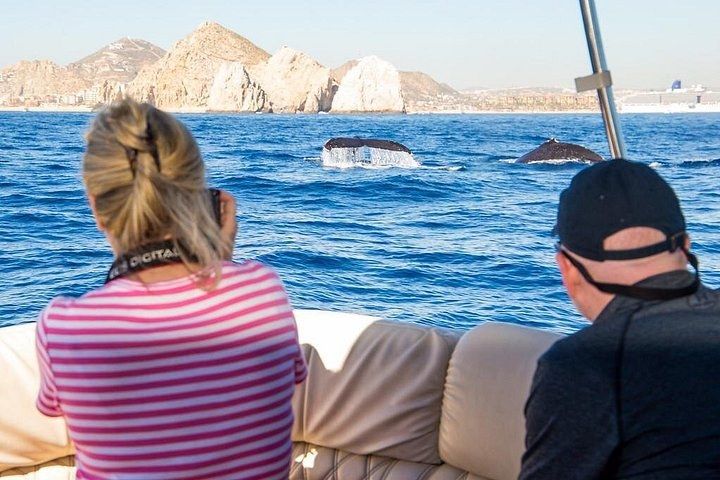
Of the whale watching tours Cabo San Lucas travellers take in winter, this is the narrow-focus one. The biologist spends the trip on humpback behaviour, migration, communication and conservation, and the groups are deliberately kept small, which leaves room to ask questions and gives everyone a sightline over the rail. The operator also works on photo-identification, so the flukes and dorsal shapes seen on your trip feed into data that tracks individual whales over the seasons.
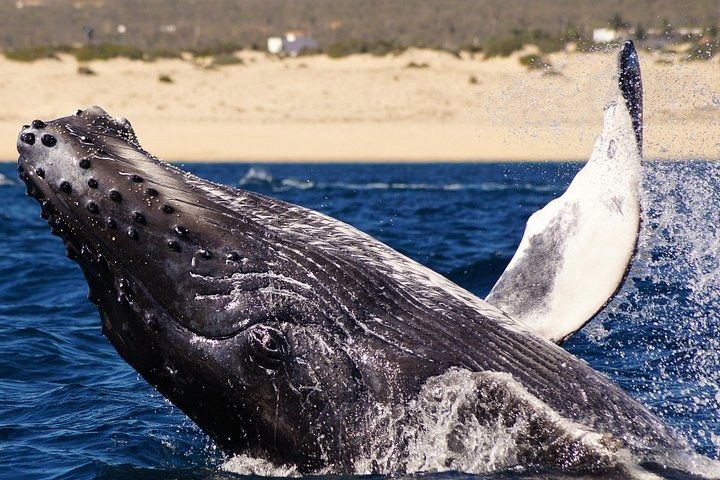
Humpbacks are the species this trip is named for, and they are the right expectation: around 60 feet long, up to about 40 tons, with flukes reaching 18 feet across and a bushy blow that stands 10 to 16 feet above the water. Calves are born at roughly 13 to 16 feet after an 11-month gestation, which is why newborns turn up in these wintering grounds alongside the adults. Breaching, spyhopping, lobtailing, pectoral slapping and logging are the behaviours boats see most often.
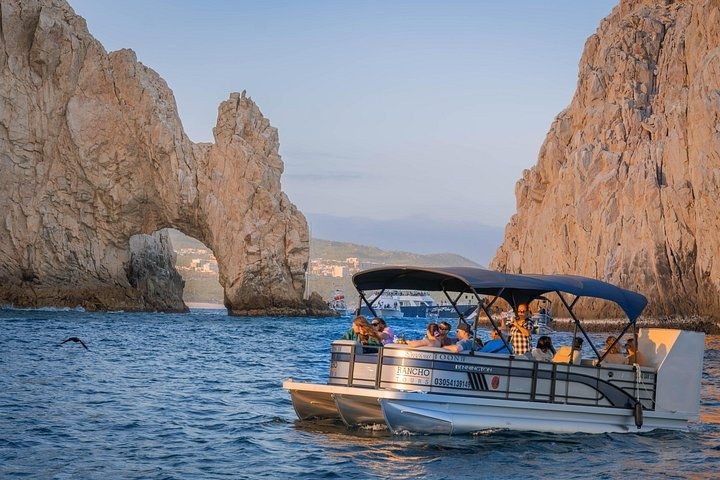
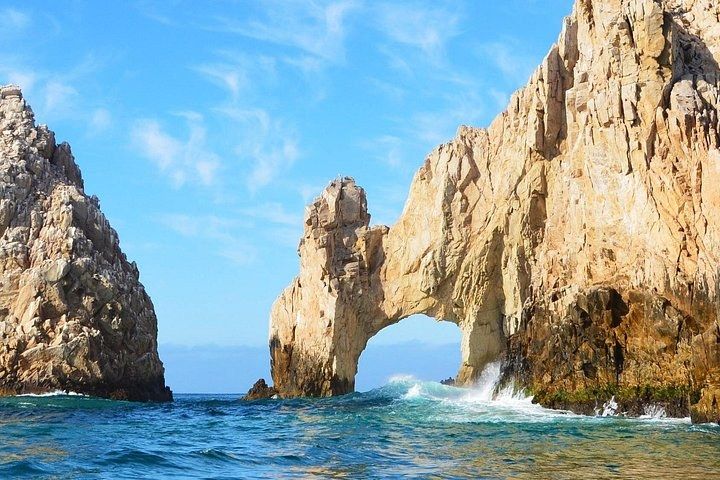
Distance on the water is set by NOM-131-SEMARNAT-2010, not by the captain's mood. Small boats under 10 m hold at least 60 m from a humpback and medium or large boats at least 80 m; no more than four boats may stay with the same whale or group, for a maximum of 30 minutes, and speed stays under 5 knots inside the observation areas. Approach to a moving whale is made on a diagonal from the rear quarter, parallel to its course, and never between a mother and her calf. Whale watching is also restricted inside the port precinct, including a 2-kilometre zone around the Arch, so boats that pass the Arch pass it as scenery and look for whales further out.
The season is fixed by federal notice: SEMARNAT authorizes whale watching in the Cabo San Lucas area from 15 December 2026 to 30 April 2027, and the Los Cabos tourism board puts the peak between January and March. Mornings are the better bet if you are sensitive to motion, since the tourism board notes calmer seas and softer light early; on 15 January the sun rises at 07:03 and sets at 17:56. Mean air temperature runs 22.1 C in December, 21.2 C in January and 20.9 C in February, with wind averaging about 3.9 m/s from the north-northwest, so bring a windbreaker even on a bright day.
The humpback trip with a biologist on board
2.5 hours from the Cabo San Lucas marina, from $99 per adult, rated 4.9 ★ by 1,065 travellers. Bottled water and marine park fees are included.
Meeting point: the office inside the Tesoro Hotel, Local A-20, right at the Cabo San Lucas marina. It sits close to dock M-O, next to the white lighthouse with a red stripe, and behind the D'Right Joint restaurant.
Hotel pickup and drop-off are not included, so plan your own ride to the marina. Blue and green taxi vans work in Cabo San Lucas around the clock, the Ruta del Desierto bus links San Jose del Cabo and Cabo San Lucas in about an hour for between 2 and 3 US dollars, and a taxi or van between the two cities runs around 60 to 70 US dollars.
Arrive with time in hand: the operator has to brief passengers on required behaviour before the boat leaves, and authorized boats fly the SEMARNAT whale-watching flag for the season.
Cancellation: for a full refund, cancel at least 24 hours before the scheduled departure time.
Ages: infant 1–5, child 6–11, adult 12+
Photos: ours and the tour operator's
What is included
Included
Bottled water
Marine park fees
Marine biologist guide
2.5-hour boat ride
Not included
Souvenir photos (available to purchase)
Hotel pickup and drop-off
Other whale watching tours from Cabo San Lucas compared
The four alternatives below also run 2.5 hours. Three of them go out by zodiac, which puts you lower and closer to the waterline in a small group, and one of those includes photos so you can watch instead of shooting. The lunch cruise is the slower version of the same morning, with food on board and more deck space to move around. This page's trip stays the simplest of the set: a biologist, bottled water, marine park fees and no extras to decide about.
Tour
Length
From
Rating
Humpback Whale Watching Tour in Cabo San Lucas (this page)
The 2.5-hour trip runs from the Tesoro Hotel office at the Cabo San Lucas marina, from $99 per adult, with a marine biologist on board. Morning slots fill first in the January to March peak.