In shortGray whale watching Magdalena Bay from Cabo takes a full day on the road. The eye-level encounters happen in the Pacific lagoons north of the cape: a day running roughly 05:00 to 19:00, with about five hours of driving each way and up to three hours on the water in small skiffs. Local Cabo departures last 2 to 2.5 hours and work humpback water.
05:00 to 19:00Length of the lagoon day
about 5 hoursDriving each way
up to 3 hoursOn the water at the lagoons
2 to 2.5 hoursLocal departure from the marina
What a full day gray whale watching tour from Cabo to Mag Bay involves
The clock is the thing to understand before you book. A licensed Cabo operator's gray whale day runs from about 05:00 to 19:00, with roughly five hours of driving each way and up to three hours on the water once you arrive. Every version of this trip has the same shape: a long highway day on either side of a short, fixed window in a skiff.
These departures are not a daily service. They sit on fixed dates in February and early March, which falls inside the January to March peak, and they sell out well before the dates arrive. Book it weeks ahead and build the rest of your week around it rather than hoping to slot it in once you land.
Plan on being out in the dark at both ends. On 15 February the sun sets at the cape at 18:16 with civil twilight finishing at 18:39, so a 19:00 return means the last part of the drive is at night, and the start is well before the 06:52 sunrise.
- Roughly 05:00 to 19:00 from start to finish
- About five hours of driving in each direction
- Up to three hours on the water in the lagoon
- Fixed dates in February and early March, which sell out
What the gray whale lagoons in Baja are like
The lagoons sit on the Pacific side of the peninsula, a long way north of Los Cabos, and the water inside them is shallow and sheltered rather than open sea. You go out in small skiffs with a handful of people aboard, sitting low to the surface, and the motion bears no relation to the swell that runs past Land's End on a windy March morning.
Gray whales behave differently there than they do off the cape. A whale passing Cabo San Lucas is travelling, and a permitted boat reads a blow and a back at legal distance while the animal keeps moving. In the lagoons the whales are not going anywhere: mothers hold station with calves alongside, boats sit still with engines idling, and the animals are the ones deciding how close the encounter gets. That is why lagoon photographs look nothing like photographs from a 2.5-hour departure out of the marina.
One thing worth setting straight before you spend the day: a close approach is still an approach by the whale, under the same federal observation rules that apply at the cape. Nobody can promise you one, and the skiff crew cannot go and get it for you.
Touching and swimming with whales are banned in Mexico
Mexico's observation standard, NOM-131-SEMARNAT-2010, prohibits swimming, diving, fishing, water-skiing and parasailing during whale observation, and bans the use of sonar or echo sounders to locate whales. Reaching whales under your own power is out as well: jet skis, kayaks, canoes and paddle-powered inflatables are all excluded from whale watching, in the lagoons as much as at the cape. Nursery water brings one rule into sharp focus, because a hull is never allowed to put itself between a mother and her calf, and whales that are mating or giving birth are left alone. Swimming with whales is illegal in Cabo, and putting your hands on an animal is not something a compliant crew will offer.
The numbers that govern a trip are checkable. Four boats is the ceiling around any one whale or group; the clock on that group stops at 30 minutes; anyone queueing for a turn holds 240 metres back; speed stays under 5 knots once inside an observation area, with entry made at about 2 knots; and a whale that is travelling gets taken from the rear quarter, on a diagonal that runs parallel to its course.
The company selling you the day has to hold a SEMARNAT authorization for non-extractive use of wildlife before it can offer whale watching at all. The boat you climb into carries an official identifying marker somewhere you can see it, and the flag SEMARNAT issues to each authorized company at the start of a season has a number in its bottom right corner for that year and stays flying for as long as the boat is whale watching. The pre-departure briefing on how passengers must behave is also a legal requirement, so if nobody gives you one, you are already on a trip that is not following the rules.
If being in the water with a cetacean is the actual goal, there is one legal route in this state and it does not involve whales. That route runs to La Ventana, where Baja California Sur became the first Mexican state to allow swimming with orcas, under a pilot scheme that caps the water at 24 boats a day, and getting there from Los Cabos is a commitment of at least six hours.
The local trip from the marina runs 2 to 2.5 hours
Whale watching at the cape is switched on by federal notice, and for 2026-2027 the authorized window in the Cabo San Lucas area is 15 December 2026 to 30 April 2027, with the official Los Cabos tourism board placing the busiest stretch between January and March. Gray whales are part of what a cape departure shows you, alongside humpbacks: those two account for most Los Cabos sightings, while blue, fin and orca turn up far less often.
Two pieces of geography explain why a local trip looks the way it does. Whale-watching activity is barred from the northern section of the protected-area polygon that falls inside the port precinct, a closure that takes in a 2-kilometre zone around the Arch, and from a 1-kilometre strip along the polygon's eastern boundary running seaward from Punta Ballenas. So the boat passes the rock formations as scenery and then goes looking for animals in the water outside those circles, holding somewhere around 60 to 80 metres off depending on hull size.
Take the first departure of the day. The official tourism board's advice is that early trips get calmer seas and softer light, and flat water matters when the crew has to hold position at that distance and read the surface for the next blow. Averages at 10 metres go 3.9 m/s in December, January and February, then 4.1 m/s in March and 4.3 m/s in April, all out of the north-northwest, so a late-season departure has more breeze in it than a January one.
If whale song is part of what you want, book a boat with a hydrophone. The engine may legally be cut only while a hydrophone is in use, which is the one configuration that buys you silence instead of a diesel idling behind you, and a complete male humpback song runs 7 to 30 minutes with the singer holding more or less one position throughout.
The humpback trip from the marina
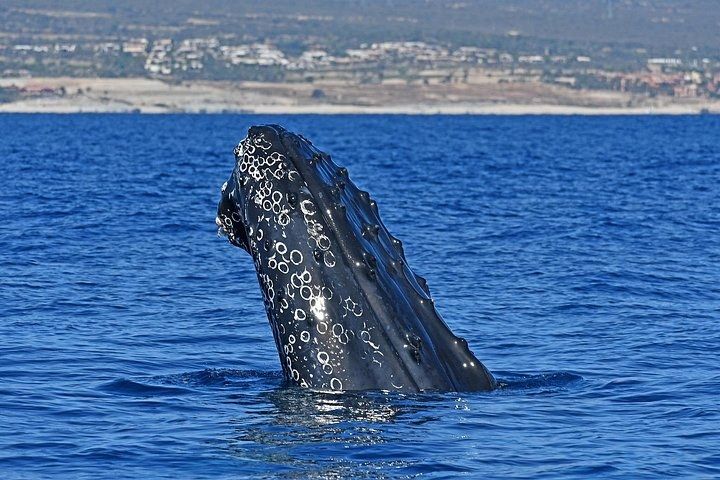
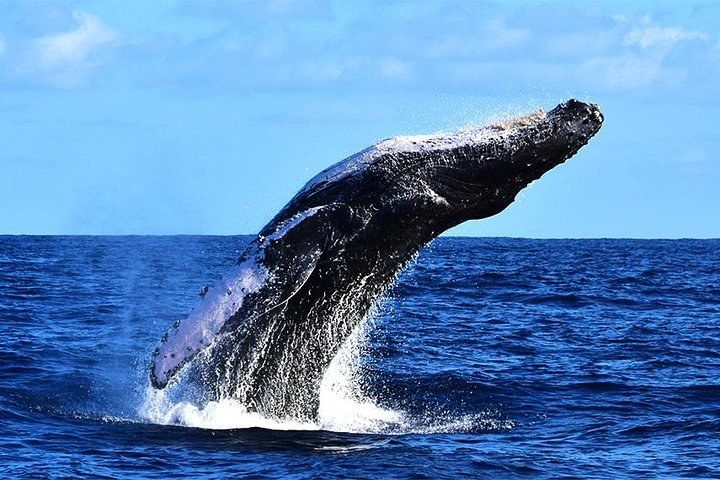
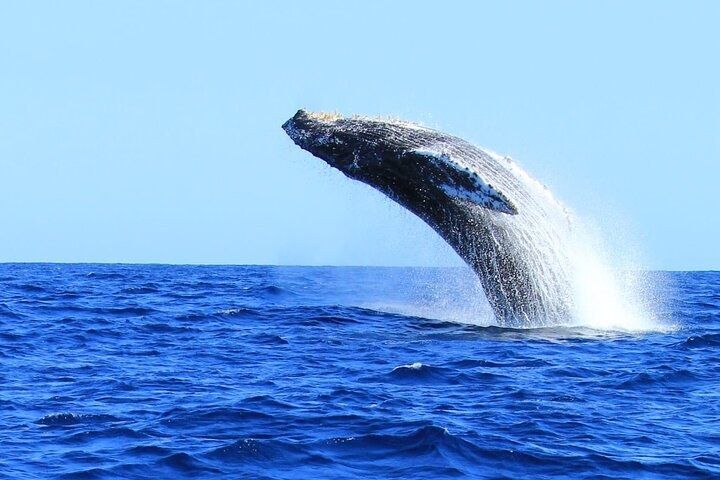
If you decide the road day is not worth it, this 2.5-hour departure goes out with a marine biologist guide, bottled water and marine park fees included, from $99 and rated 4.9 ★ (1065 reviews), meeting at the Tesoro Hotel office, Local A-20, close to dock M-O.
★ 4.9/5 · 1,065 reviews
How to decide between the two
Take the local boat tour. Add the Pacific lagoon day only if a close gray whale encounter is genuinely the point of your holiday, your dates land in February or very early March, and you are willing to hand over a whole day, roughly 05:00 to 19:00, with about ten hours of it in a vehicle. For most visitors with a week in Los Cabos, that day costs more hours than it gives back.
Do not treat the lagoon trip as a replacement for a departure from the marina. They show you different water and, through the peak, largely different animals: the cape is where humpbacks winter, and a 2 to 2.5 hour trip there is built around them. If you do both, put them on separate days and keep the local trip early in your stay.
Think about who is coming. A pre-dawn start and a long drive is a lot for small children, and susceptibility to motion sickness peaks between the ages of 7 and 12 before declining through adulthood, with under-twos usually unaffected. The CDC's practical advice is useful on either trip: keep a visual horizon reference, stay out of the areas of maximum motion such as the bow, limit head movements, skip reading and visual scanning, avoid alcohol and smoking, and get fresh air on your face. Sleep deprivation makes it worse, which is worth remembering before a 05:00 departure.
| What you are comparing | Local departure from Cabo San Lucas | Pacific lagoon day trip |
|---|
| Total time committed | 2 to 2.5 hours | About 05:00 to 19:00 |
|---|
| Travel to the whales | Marina in Cabo San Lucas | Roughly five hours behind the wheel in each direction |
|---|
| Time actually on the water | 2 to 2.5 hours | Up to three hours |
|---|
| Dates | Federal notice allows 15 December 2026 through 30 April 2027, busiest January to March | Fixed dates in February and early March |
|---|
| What you usually watch | Humpbacks through the peak, gray whales also seen | Gray whales in sheltered lagoon water |
|---|
| Boat | 2-hour or 2.5-hour tour boat or catamaran | Small skiff |
|---|
| Distance from the animal | Roughly 60 to 80 metres, by vessel size | Set by the same federal rules; a close approach is the whale's choice |
|---|
Questions people ask
Can you touch or swim with the friendly gray whales in Baja?
No. Swimming and diving are prohibited during whale observation under Mexico's NOM-131-SEMARNAT-2010, and swimming with whales is illegal in Cabo. A boat is also barred from slotting itself between a mother and her calf. The only legal in-water cetacean activity in Baja California Sur is with orcas at La Ventana, under a pilot scheme capped at 24 boats a day and at least six hours away from Los Cabos.
Do gray whales come close to the boats off Cabo San Lucas?
Gray and humpback whales are the two species most commonly seen in Los Cabos, but a local departure watches them at the distance the rules set, roughly 60 to 80 metres depending on the size of the vessel. The whales off the cape are also moving through rather than holding station in nursery water. Eye-level encounters are a feature of the Pacific lagoons, which is why they take a full day to reach.
When should I book the lagoon day trip?
As early as you can. The departures run on fixed dates in February and early March and get marked sold out, so there is no walk-up version of this trip. February also sits inside the January to March peak, with mean wind at the cape around 3.9 m/s, which is the calmest part of the season for the boat day you book at the marina.
Does the Cabo whale-watching season apply to the lagoons too?
Each season's dates and zones come from a fresh SEMARNAT notice, and the 2026-2027 one carries a Mexico City signature dated 22 October 2026. The only dates that notice confirms for this site's area are 15 December 2026 to 30 April 2027 in the Cabo San Lucas area, including San Jose del Cabo and Cabo Pulmo National Park. For anywhere else, check the current notice rather than an operator calendar.
What should I bring for a 14-hour day out of Cabo?
Layers with a windproof outer, because air temperature at the cape averages 20.9 C in February and the breeze comes from the north-northwest, and sun cover that lasts a full open-skiff session. For photographs, set the camera before you leave: Shutter Priority at 1/1000 second, ISO on Auto, a high burst rate, and the sun behind your shoulder. Eat and sleep properly the night before, since sleep deprivation worsens motion sickness.
Read also