In shortWhales are sometimes sighted in November, but no boat there can sell you a whale-watching trip: the 2026-2027 federal notice authorizes the activity in the Cabo San Lucas area only from 15 December 2026 to 30 April 2027. November departures are marine wildlife outings around the headland, past the Arch, Lovers Beach and Pelican Rock, with whales down to luck.
15 Dec 2026Season opens at the cape
30 Apr 2027Last authorized day
4.3 m/sApril mean wind at 10 m
from $1292.5-hour catamaran trip
Can you see whales in Cabo in November?
Whales do turn up in front of the cape in November, and no boat there can legally sell you a search for them. The 2026-2027 notice, signed by SEMARNAT in Mexico City on 22 October 2026, switches the activity on in the Cabo San Lucas area on 15 December 2026 and holds it open to 30 April 2027. The paperwork is what rules November out: a company needs a SEMARNAT authorization for non-extractive use of wildlife before it can take anyone whale watching, and that authorization is valid only within the dates the notice names.
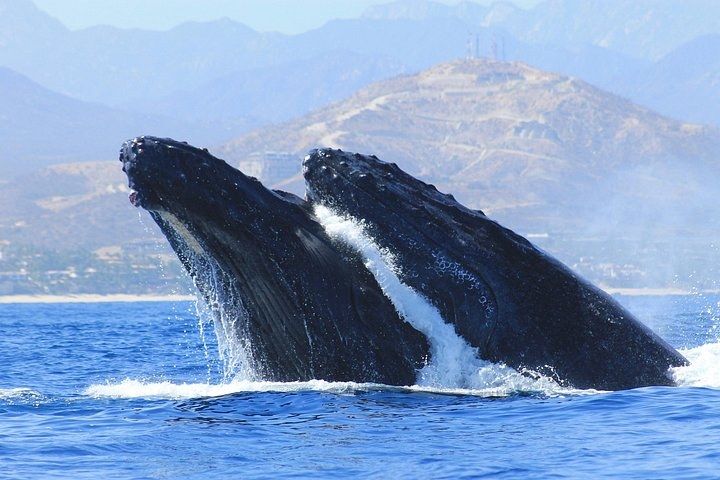
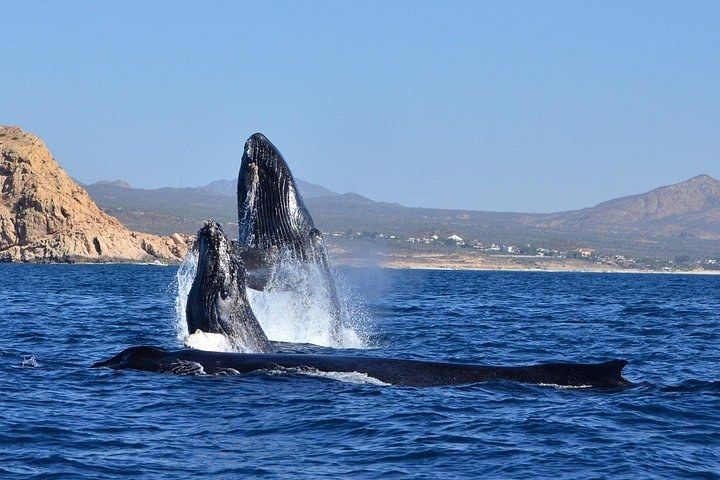
No official source gives a biological arrival date for the humpbacks. The migration itself is documented: the population that winters off Mexico breeds along the Pacific coast and the Revillagigedo Islands, transits the Baja California Peninsula and feeds from California up to the Aleutian Islands, and some populations cover roughly 5,000 miles between the two ends of that route. Animals that run it early are in the water before the notice opens, which is why November visitors do sometimes see a bushy blow 10 to 16 feet high from a sightseeing boat.
Build a November trip around the coastline, the protected water at the cape and the sand falls, and count a whale as luck. If your dates straddle the opening, move the boat day to 15 December or later, when the crews are authorized to go looking.
What the marina sells between 15 November and 14 December
From 15 November to 14 December the offices on Boulevard Marina switch their 2.5-hour departures to marine wildlife outings of the Arch, Lovers Beach and Pelican Rock. One operator publishes an early-season sighting chance of 70 to 90 percent for that stretch. That figure is its own marketing, and no official sighting statistics exist for Cabo San Lucas to check it against.
Judge the outing by the coastline. The crew is not permitted to run a whale search, so there is no queueing for a turn, no 30-minute clock on an animal and nothing owed to you if nothing surfaces. The Arch also gets attention it never gets later in the winter: during the authorized season the northern part of the protected-area polygon inside the port precinct is closed to whale-watching boats, including a 2-kilometre zone drawn around the Arch, plus a 1-kilometre strip along the eastern boundary running seaward from Punta Ballenas.
Two rules carry over from the season proper. Swimming with whales is illegal in Cabo at any time of year, and jet skis, kayaks, canoes and paddle-powered inflatables may never be used for whale watching. If an in-water encounter is the whole reason you are travelling, the whale shark activity at La Paz has its own season from October through May, with boats capped at 36 feet and groups of five, and it has been suspended mid-season in the past.
The catamaran inside the authorized window
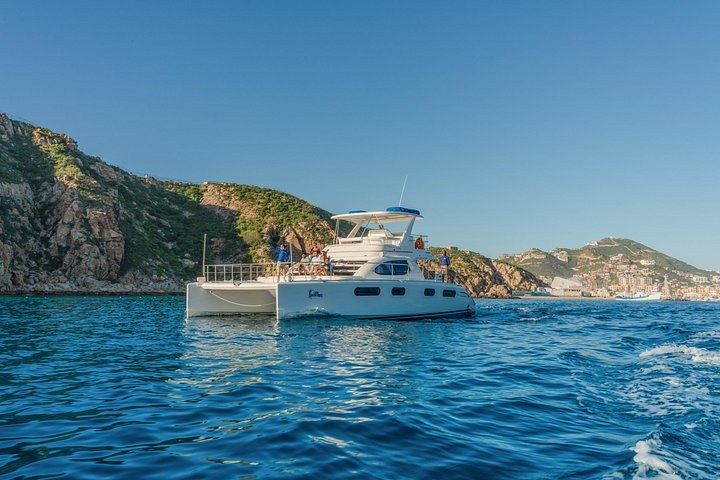
If your dates slide past 15 December or sit in the last fortnight of April, this 2.5-hour trip runs inside the federal window and carries the hydrophone that lets the crew cut the engine while a whale sings.
★ 4.9/5 · 2,294 reviews
When does whale season end in Cabo
The legal end date for 2026-2027 is 30 April 2027. Driving east does not buy you extra days: the same cut-off applies across the Cabo San Lucas Flora and Fauna Protection Area, which takes in San Jose del Cabo, and inside Cabo Pulmo National Park, where whale-watching boats are kept off a 3.5-kilometre coastal strip at Los Frailes for the whole season.
Licensed operators publish seasons of 15 December to 15 April, and the official Los Cabos tourism board describes the window loosely as early December through mid-April, varying year to year. The notice is the enforceable document, so the final two weeks of April are live even when the market behaves as though they are not. A new notice comes out each autumn, so check the current one if you are booking a year ahead.
Nothing is authorized in May. If your dates land after the 30th, there is no whale-watching product to buy at the cape, and the next season's start depends on a notice that will not exist until the following October.
| Period | Authorized for whale watching | What is on sale | Worth booking |
|---|
| 15 Nov to 14 Dec 2026 | No | Sightseeing runs of 2.5 hours along the headland: the Arch, Lovers Beach, Pelican Rock | Only as sightseeing, with whales down to luck |
|---|
| From 15 Dec 2026 | Yes, opening day | Whale-watching departures | Yes, with numbers still building |
|---|
| January to March 2027 | Yes | Full schedule, peak of the season | The stretch to aim for |
|---|
| 1 to 30 Apr 2027 | Yes, to the 30th | Whale-watching departures, thinner demand | Yes, if you accept lower odds |
|---|
| May 2027 | No | No whale-watching product at the cape | Plan the water day around something else |
|---|
How April differs from the middle of the season
April sits outside the January to March peak, and the air is the first thing you notice. Mean wind at 10 metres rises to 4.3 m/s in April, the highest of the five authorized months, out of an average bearing of 306 degrees, against 3.9 m/s through December, January and February. Wind counts for more than the choice of boat, because a permitted vessel works from roughly 60 to 80 metres off the animal depending on its size, and most of a 2.5-hour trip goes on reading the surface at that range.
Mean air temperature in April is 22.2 C, the warmest of the window, and the tourism board puts March and April in the low 80s Fahrenheit. Daylight is at its longest: on 15 April the sun is up at 05:59 and down at 18:40, with civil twilight running to 19:03, so a late departure has something to work with instead of finishing in the dark.
Mothers with calves can still be along the coast. An April calf is well grown by then: gestation runs 11 months, newborns measure about 13 to 16 feet, and weaning comes up to a year after birth, which leaves pairs travelling together at the back end of the window. No official source counts how many remain, and the success rates operators advertise are marketing claims rather than measured figures, so go out expecting a search.
The on-water limits hold at any date: four boats maximum around one whale or group, 30 minutes maximum on the same animals, 240 metres while you wait your turn, under 5 knots inside the observation area and about 2 knots on entering it. In a crowded February those caps mean queueing. In late April they usually mean your turn comes straight away, on a boat carrying fewer people.
Is an edge-of-season trip worth booking
For April, yes, and take the first morning slot. The wind is the reason: the official tourism board says early departures give you calmer water and gentler light, and that is the one variable left to you once your dates are fixed. Pick a boat with a hydrophone: Mexican rules let a crew switch the engine off only while a hydrophone is in use, and a complete male song lasts 7 to 30 minutes, with singers staying more or less in one place while they perform.
For November, book the coastline outing on its own merits and keep your expectations where the law puts them. Before you pay for anything inside the season, ask to see the SEMARNAT whale-watching flag with this season's number in the bottom right corner; authorized boats must also display an official identifying marker where it can be seen and fly that flag at all times while whale watching. An unpermitted boat has to sit roughly 800 feet off a whale, so whatever it promised you at the dock is a distance it cannot legally close.
The Cabo San Lucas Luxury Catamaran Whale Watching is the trip on this site to hold on to if your dates sit at either edge of the authorized period: 2.5 hours, from $129, 4.9 ★ (2294 reviews), a hydrophone fitted, snacks and alcoholic beverages aboard, and departures anywhere between 15 December and 30 April. Two items are settled at the marina rather than online, the round-trip transportation fee paid at check-in and the dock entrance fee, which sits outside the ticket.
- Arriving any time in November: a 2.5-hour coastline outing past the Arch, Lovers Beach and Pelican Rock, valued as sightseeing
- Arriving 1 to 14 December: the same product, with whale-watching departures starting the day you reach the 15th
- Arriving in April: book the morning slot on a hydrophone boat and accept thinner numbers than February
- Arriving after 30 April: no authorized whale watching at the cape, at Cabo Pulmo or at San Jose del Cabo
- At any date: no legal tour in Cabo puts you in the water with a whale
Questions people ask
Can you see whales in Cabo in May?
Not on a boat trip sold as whale watching. The 2026-2027 notice closes the activity in the Cabo San Lucas area on 30 April 2027, and the same end date applies to San Jose del Cabo and to Cabo Pulmo National Park. Dates for the following season come from a new SEMARNAT notice issued the next autumn.
Why can boats not run whale-watching tours in November?
Whale watching in Mexico requires a SEMARNAT authorization for non-extractive use of wildlife, and the annual notice sets the period and the zones in which that authorization applies. For 2026-2027 the period in the Cabo San Lucas area begins on 15 December 2026. Authorized companies also fly a flag issued for the season, numbered for the year, whenever they are whale watching.
Will there still be calves in the water in late April?
It happens. Nursing runs up to a year, and a newborn already measures about 13 to 16 feet when it arrives after the 11-month gestation, so mothers and young are not pushed out of the area by the end of the window. No official count exists for how many remain that late, and boats may not place themselves between a mother and calf in any case.
How warm is it at the cape at the end of the season?
April has the warmest mean air temperature of the authorized months at 22.2 C, and the tourism board describes March and April as reaching the low 80s Fahrenheit. Sea temperature is the least predictable figure: the satellite reading off the cape was 23.4 C on 15 March 2026, against 23.5 C on 15 February 2026 and 19.9 C on the same date in 2025.
Is the April light good enough for a sunset departure?
Yes. On 15 April sunset at Cabo San Lucas falls at 18:40 with civil twilight running to 19:03, the longest usable evening of the window, and the tourism board notes that sunset trips give the warmest low-angle light. April also carries the season's highest mean wind at 4.3 m/s, so a late slot suits photography more than a sensitive stomach.
Read also