In shortThe whale watching season at Cabo San Lucas is set by federal notice: SEMARNAT authorized 15 December 2026 to 30 April 2027 for the Cabo San Lucas area, including San Jose del Cabo, and the same dates for Cabo Pulmo. The official tourism board describes it loosely as early December to mid-April, varying year to year, and places the peak from January to March, when humpback and gray whales are the usual sightings.
Opens 15 Dec 2026, closes 30 Apr 2027Authorized season window
January to MarchPeak of the season
3,996.04 hectaresProtected area at the cape
from $992.5-hour humpback trip
When is whale season in Cabo?
Mexico sets the season by decree. SEMARNAT, the federal environment ministry, issues a notice before each winter naming the areas where whale watching may be carried out and the exact days it may run. The notice covering 2026-2027 carries a Mexico City signature date of 22 October 2026, and it opens the activity in the Cabo San Lucas area on 15 December 2026 and closes it on 30 April 2027.
The authorization is attached to a protected area rather than to a town. It applies to the Área de Protección de Flora y Fauna Cabo San Lucas, which takes in San Jose del Cabo, and the same period was set for Cabo Pulmo National Park on the East Cape. Any company taking passengers out must first hold a SEMARNAT authorization for non-extractive use of wildlife, and its boat has to display an official identifying marker where you can see it while the service is running.
Shifting dates are normal, because the notice is drafted and signed afresh every autumn. Last winter's figures tell you nothing about your own dates. Check them against the notice in force for the season you are travelling in.
The legal window and the dates in the brochures
The official Los Cabos tourism board describes things more loosely: a season beginning in early December and lasting through mid-April, and it states openly that this varies year to year. In another place the same board frames the window as December through April, with gray and humpback whales moving along the coast with their young. Those descriptions track the animals; the federal notice governs what boats may legally do.
Operator calendars are usually shorter again. Some publish a season of 15 December to 15 April and stop selling after that, which for 2026-2027 makes the last two authorized weeks of April look closed when the notice still has them open. If your flights land in the second half of April, read the current notice before writing the trip off.
The front end does not stretch the same way. Dedicated whale-watching tours cannot be sold before 15 December, so in the run-up to the opening the marina offices switch to marine wildlife sightseeing runs past the Arch, Lovers Beach and Pelican Rock. Book that kind of trip for the coastline, with a whale as luck rather than as the reason you paid.
The focused humpback trip
A 2.5-hour run with a marine biologist guide and marine park fees included, from $99, rated 4.9 ★ (1065 reviews), working the authorized water offshore rather than lingering at the Arch.
★ 4.9/5 · 1,065 reviews
Where boat observation is restricted inside the protected area
The authorized water at the cape is compact: 3,996.04 hectares in total, 3,787.99 of them marine and 208.05 terrestrial. Two slices of that polygon are closed to whale watching because of excessive boat traffic, and both sit exactly where first-time visitors assume the whales will be.
- Inside the port precinct, the polygon's northern end is out of bounds, and that closure takes in a 2-kilometre zone drawn around the Arch of Cabo San Lucas.
- Along the polygon's eastern boundary, a 1-kilometre band of water running seaward from Punta Ballenas is closed as well.
- At Cabo Pulmo-Los Frailes, the other authorized area in the Los Cabos municipality, a 3.5-kilometre coastal strip is closed to whale-watching boats.
Whale watching in Cabo San Lucas: best seasons and species to see
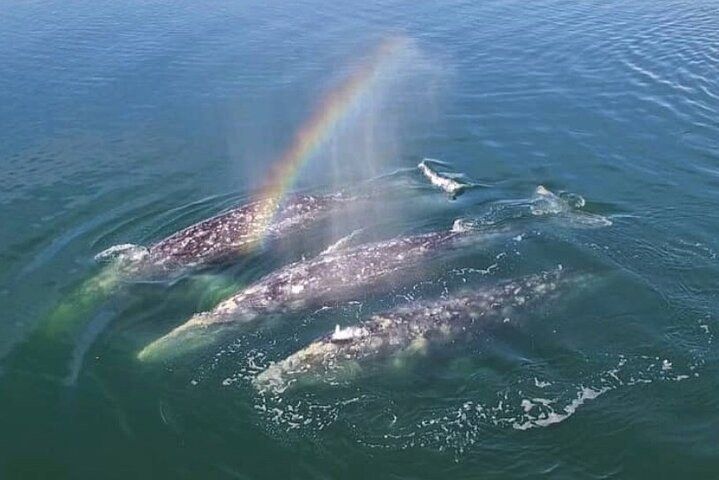
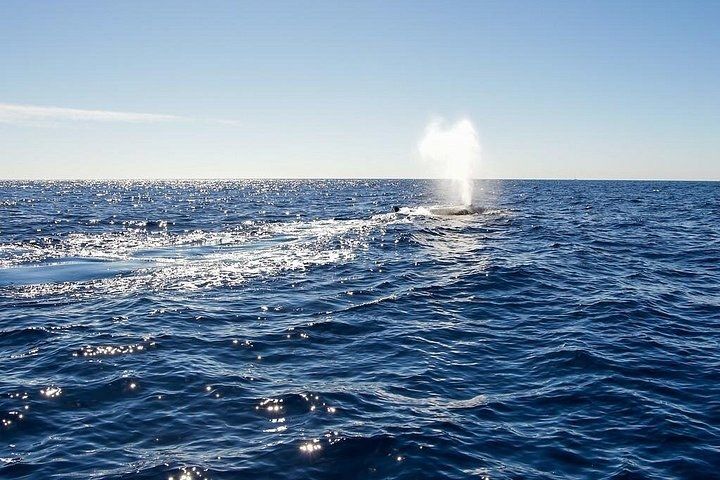
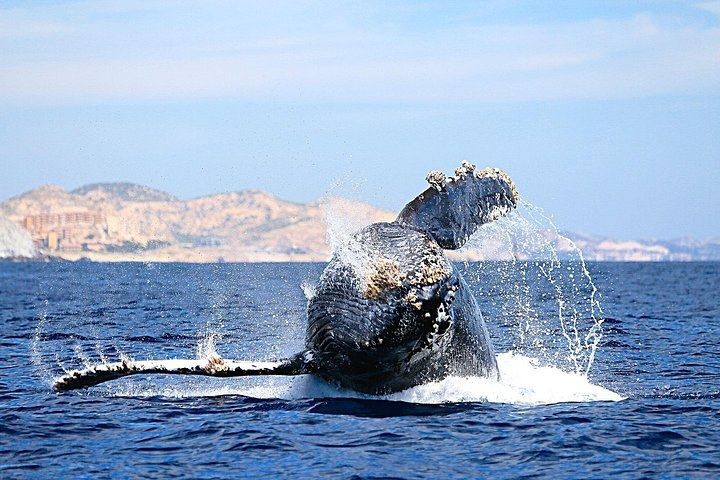
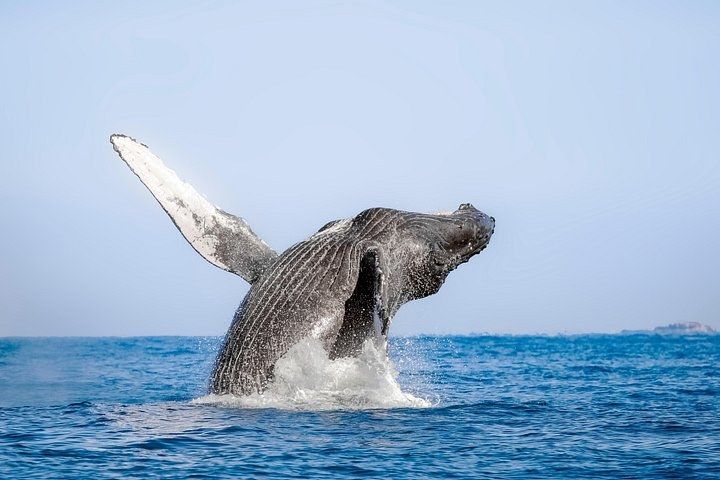
Humpback and gray whales are the two species you can reasonably expect here; blue, fin and orca sightings are far rarer. At least nine whale species live in Mexican waters and SEMARNAT classifies all of them as species at risk, which is where the distance and time limits on the water come from.
Activity builds after the opening and peaks from January to March. Humpback calves, born at about 13 to 16 feet after an 11-month gestation, are in the wintering grounds with their mothers in those weeks, and male song, which lasts 7 to 30 minutes per complete song, is most likely to be within hydrophone range of the boat. Permitted vessels work at roughly 60 to 80 metres from the animal depending on their size, so flat water helps your trip more than horsepower does.
Gray whales do pass this coast, but seeing them at eye level in the Pacific lagoons is a full-day expedition out of Cabo San Lucas with about five hours of driving each way. Keep that on a separate day from your boat trip at the cape, since the two show you different animals.
Which part of the season to travel in
Mid-January to the end of February is the stretch to aim for: inside the peak, with calves present, and with mean wind at 10 metres sitting near 3.9 m/s. March averages 4.1 m/s and April 4.3 m/s out of the north-northwest, which you feel as chop once the boat leaves the lee of the point.
Daylight is the other thing that changes across the window. On 15 December the sun rises at 06:53 and sets at 17:37; by 15 April sunrise is 05:59 and sunset 18:40, with civil twilight running to 19:03, which is what makes late-afternoon and sunset departures workable at the end of the season. Set against those times, the tourism board's advice is to take an early slot if you want calmer seas and softer light, and the sunset slot if low golden light is what you are travelling for.
Air temperature stays mild through all five months, averaging between 20.9 C in February and 22.2 C in April; the tourism board's own wording is around a comfortable 75 F from December to February, rising to the low 80s in March and April. Pack a layer for the deck, because the breeze over a moving boat takes the edge off those numbers.
Choose the month first, then the format. The month pages on this site break the window down so you can match your dates to the peak, and the two trips below run inside the authorized period: a 2.5-hour humpback trip with a marine biologist guide, from $99, rated 4.9 ★ (1065 reviews), meeting at the marina office inside the Tesoro Hotel; and the 2.5-hour luxury catamaran, from $129, rated 4.9 ★ (2294 reviews), with a hydrophone, snacks and alcoholic beverages on board.
| Period | Status for whale watching | What it means for you |
|---|
| Before 15 December 2026 | Outside the authorized window | Marine wildlife sightseeing past the Arch, Lovers Beach and Pelican Rock; whales are incidental |
|---|
| 15 December 2026 | Season opens under the federal notice | First authorized departures; shortest daylight of the window, sunset at 17:37 |
|---|
| January to March 2027 | Peak of the season | Calves in the wintering grounds, lightest average wind in January and February |
|---|
| 1 to 30 April 2027 | Authorized to the last day of the month | Longest daylight, mean wind 4.3 m/s; some operator calendars stop on 15 April |
|---|
Questions people ask
Do the whale season dates in Cabo change every year?
Yes. The season and its zones are fixed by a SEMARNAT notice issued each year, and the 2026-2027 one was signed in Mexico City on 22 October 2026. That is why dates move slightly between winters and why operator pages can be out of step with the current notice.
When do the whales arrive in Los Cabos?
The only dates confirmed by an official source are regulatory ones: observation is authorized at the cape from 15 December 2026 to 30 April 2027. The official tourism board describes the arrival-to-departure window as early December through mid-April, varying year to year, with the peak from January to March. Numbers build through the opening weeks rather than switching on overnight.
Can you watch whales next to the Arch of Cabo San Lucas?
No. For 2026-2027 the notice keeps whale-watching boats out of the polygon's northern section inside the port precinct, a closure that includes a 2-kilometre zone around the Arch, and out of a 1-kilometre band along the eastern boundary heading seaward from Punta Ballenas. A cruise that lists the Arch is showing you the rock in passing, with the whale search happening in the authorized water beyond it.
Does the same season apply in San Jose del Cabo and Cabo Pulmo?
It does. One set of dates, 15 December 2026 to 30 April 2027, governs the whole Cabo San Lucas Flora and Fauna Protection Area, San Jose del Cabo included, and Cabo Pulmo National Park on top of that. Inside Cabo Pulmo a 3.5-kilometre coastal strip at Los Frailes is closed to whale-watching boats.
Is swimming with whales allowed during the season?
No. During whale observation the rules shut out fishing, diving, swimming, water-skiing and parasailing, and whale watching may not be conducted from a jet ski, kayak, canoe or paddle-powered inflatable at any point in the season. The single legal way to get in the water with a cetacean in this state is with orcas at La Ventana, where Baja California Sur runs a pilot scheme capped at 24 boats a day, at least a six-hour commitment from Los Cabos. Whale sharks are a La Paz activity with their own October to May season.
Read also