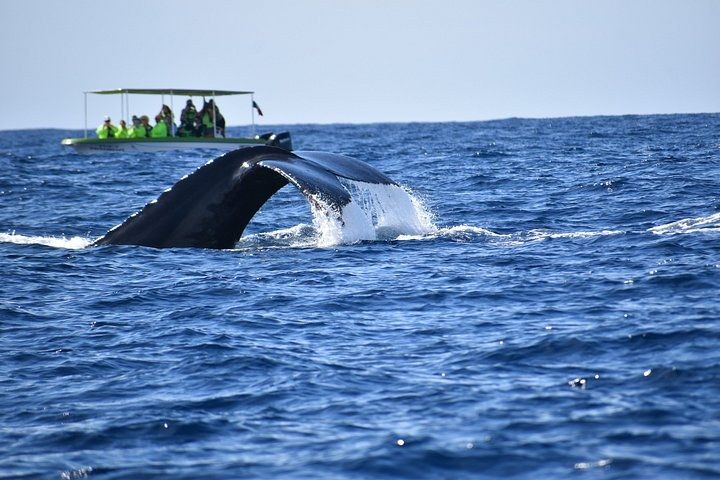
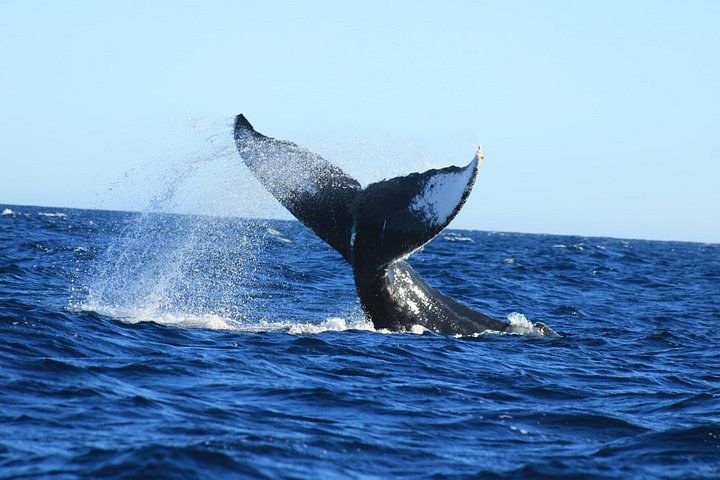
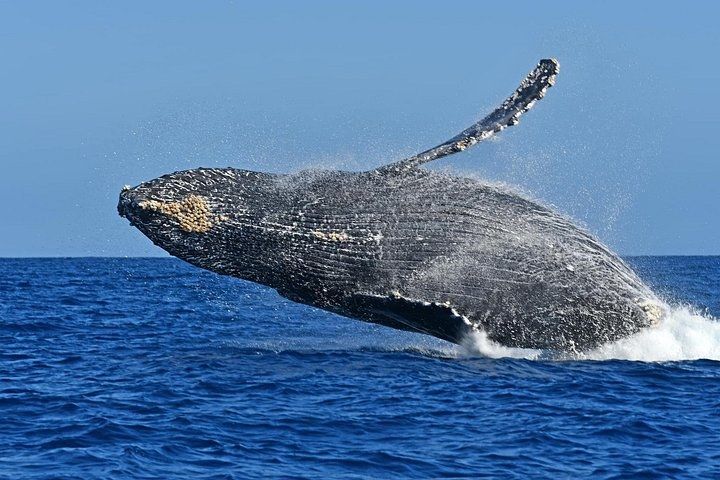
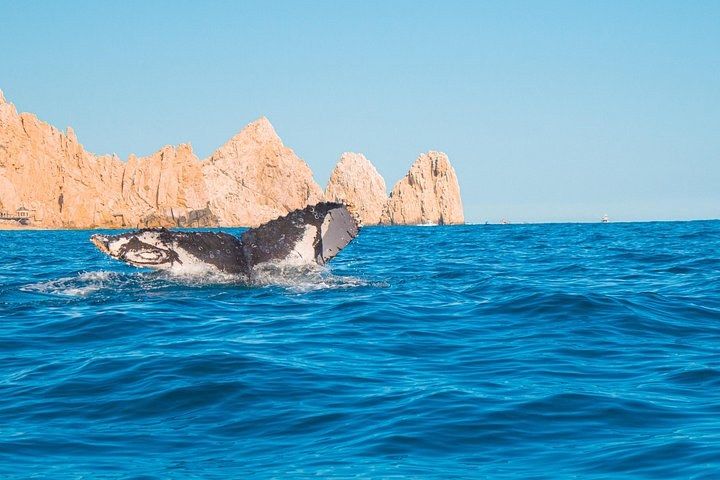
In shortA private departure changes the group size, the departure slot and how the skipper works a sighting. The regulated part stays identical: every boat holds 60 to 80 metres off a whale depending on hull size, observes one whale or group for 30 minutes at most, and waits 240 metres back behind a maximum of four boats.
max 16travellers, crewed catamaran
30 minmaximum on one whale
4 boatscap around one animal
60-80 mclosest a permitted boat works
What changes when the boat is not shared
Group size is the first thing that moves. On a shared boat you share the rail, the shaded side and the hydrophone with everyone who booked that slot. With only your party aboard, the captain is working one set of interests, so when a blow comes up on the far side the boat repositions for you rather than splitting attention between passengers who all want something different from the same two hours.
The slot is the second. Marina whale-watching offices at Cabo San Lucas run several departures a day across the authorized window, which for this season is 15 December 2026 to 30 April 2027; one marina office publishes daily hours of 07:00 to 18:00 and six runs a day. Which slot you take is worth more on a private boat than on a shared one, and the official Los Cabos tourism board's reading of the day is the one to plan around: calmer seas and softer light on the early departures, the warmest light at sunset. Confirm the actual clock time with the operator when you book, because departure times are not published consistently.
Time on the water behaves differently too. A boat may stay with the same whale or group for 30 minutes and no more, so what a quiet boat buys you is the use of the rest of the trip: going back to a singer, reading the surface instead of running for the dock, waiting out a mother and calf at the legal distance. Singing humpbacks stay more or less in one place while they perform, and a complete song lasts 7 to 30 minutes, which is why a captain who is not juggling other passengers' priorities can turn one encounter into the whole trip.
Quiet on board is a matter of equipment. While the whale is still the engine idles in neutral, and the one thing that allows a crew to cut it is a hydrophone in use. Private whale watching in Cabo San Lucas is worth little if the boat carries no hydrophone, because the silent part of the encounter depends on that equipment.
Private whale watching in Cabo San Lucas: who gets the most from it
Photographers gain the most that can actually be measured. A permitted boat works from roughly 60 to 80 metres off the animal depending on its size, so you need a clear position at the rail far more than you need a faster hull. The National Park Service technique for moving wildlife transfers straight onto a deck: keep the sun behind you, use Shutter Priority at 1/1000 second with ISO on Auto, set a high burst rate before you leave the dock, take an early frame and keep shooting. Fewer people aboard means no one steps into your line while the flukes come up, and humpback flukes run up to 18 feet across.
Families with small children get a different benefit. Before you book out a whole boat for them, check the ages: the years from 7 to 12 are when motion sickness bites hardest, susceptibility drops away after that, and under-twos rarely feel it. The CDC countermeasures are easier to apply when the deck is not full: keep a visual horizon reference, stay out of the bow where motion is greatest, avoid head movements and avoid reading or scanning, get fresh air on the face. A restroom on board is stated for the small-group biologist trip on this site, which matters on a 2.5-hour departure with a toddler.
For an occasion, the open-bar formats make sense, with the caveat that the legal drinking age in Mexico is 18 and that alcohol increases motion sickness. Take the drinks on the way back rather than on the way out.
Shade and seating are the two things to settle before you pay. A smaller passenger count means you choose where you sit and can move to the shaded side when the sun climbs; solar noon at the cape falls at 12:29 on 15 January and 12:34 on 15 February, and the deck is open to a north-northwest breeze averaging 3.9 to 4.3 m/s with winter peaks around 10 to 12 m/s. Mean air temperature runs between 20.9 C in February and 22.2 C in April, so layers with a windproof outer and sun cover that lasts the full two to two and a half hours are the right kit. Check the tour page for what is actually described on board rather than assuming a deck layout.
Small group whale watching in Cabo with a marine biologist
The biologist-led small-group format sits between a full boat and having the vessel to yourselves, and for most visitors it is the better buy. Priced from $109 for 2.5 hours and rated 4.9 ★ (1256 reviews), the Small-Group Whale Watch with Marine Biologist in Cabo San Lucas delivers most of what people charter a boat for: hydrophone listening, a restroom on board, and the guide's photos handed over at no extra charge. Carry your own water, because single-use plastic bottles have been dropped from the boat, and budget separately for transportation and gratuities, since neither is included. Check-in is at Plaza Bonita inside the Cabo San Lucas Marina; coming from the road you look behind Starbucks, and walking in along the marina you look behind Nowhere Bar.
A biologist aboard changes what you understand of a sighting. At least nine whale species live in Mexican waters and all of them are classified by SEMARNAT as species at risk; humpback and gray are the two you are realistically looking at off Los Cabos, with blue, fin and orca far rarer. Someone who can read a bushy blow 10 to 16 feet high, tell lobtailing from pectoral slapping, and explain why the boat is approaching on a diagonal from the rear quarter is the difference between watching a back and following a behaviour.
Responsible-operator recognition exists in this market and is worth asking about. One Cabo ecotourism company states it was the first in Mexico to receive the World Cetacean Alliance's Responsible Whale Watching Operator recognition, and runs marine-biologist-led trips from an office on Boulevard Marina. Recognition of that kind sits on top of the licence rather than replacing it, so check two things before you pay for a small or private boat: whether the company holds a SEMARNAT authorization for non-extractive use of wildlife, and whether this season's flag is flying, because SEMARNAT issues each authorized company a new one every season with a number in the bottom right corner identifying the year, and it stays up throughout the whale watching. Authorized boats also carry an official identifying marker somewhere visible.
Every trip must begin with a passenger briefing on required behaviour, with the rules displayed on visible signage. If nobody briefs you before you leave the dock, the trip is already out of compliance, and that is true on a boat of four people as much as on a boat of forty.
The small-group biologist boat
Fewer people around the hydrophone, a marine biologist reading the surface and a restroom on board, over 2.5 hours from the Cabo San Lucas Marina.
★ 4.9/5 · 1,256 reviews
The limits that apply to every boat at the cape
No amount of exclusivity moves the numbers in NOM-131-SEMARNAT-2010. They are the reason a well-run encounter looks restrained, and they are the four or five things to hold any operator to while you are on the water.
Geography is fixed as well. A chartered hull gets no further into the closed water than a shared one: for 2026-2027 the federal notice puts the northern part of the Cabo San Lucas protected-area polygon, the stretch inside the port precinct, off limits for whale watching, drawing a 2-kilometre zone around the Arch and a 1-kilometre strip along the eastern boundary running seaward from Punta Ballenas. The Arch is scenery at the start or end of a trip; the whales are found in the rest of the polygon, 3,996.04 hectares in total with 3,787.99 of them marine. Booking a boat down the coast changes little, because the municipality's other authorized area, Cabo Pulmo-Los Frailes, has a 3.5-kilometre coastal strip barred to whale-watching boats.
Getting in the water is not an option on any boat here. A deck you have paid for in full does not extend the list of things you may do on it: while whales are being observed there is no fishing, diving, swimming, water-skiing or parasailing, no sonar or echo sounder to locate the animals, and no whale watching at all from jet skis, kayaks, canoes or paddle-powered inflatables.
| Rule | What it means on the water |
|---|
| Minimum distance | At least 60 m for boats under 10 m, at least 80 m for medium or large vessels |
|---|
| Boats per whale | Four at most around the same whale or group |
|---|
| Time on one group | 30 minutes maximum, then the boat moves on |
|---|
| Waiting your turn | 240 metres back from the whale or group |
|---|
| Speed | Under 5 knots inside the observation area, about 2 knots on entering it |
|---|
| Approach | Diagonal from the rear quarter, parallel to the whale's course, never head-on |
|---|
| Engine | In neutral while the whale is still, off only while a hydrophone is in use |
|---|
| Never | Between a mother and calf, or near whales mating or giving birth |
|---|
| Without a permit | A boat must stay about 800 feet off, far outside what it would be selling you |
|---|
Choosing between the small-group boat and the premium departure
Default to the small-group biologist trip. It gives you the two things that change the encounter, a hydrophone and someone who can explain what the animal is doing, plus a restroom and photos included, over 2.5 hours rather than two. That is the format to book for the January to March peak, when calves born at about 13 to 16 feet are in the wintering grounds with their mothers and male song is most likely to be within hydrophone range.
Choose the premium catamaran departure when the point is the occasion and the comfort rather than the biology: a crewed vessel capped at 16 travellers, a live guide in English, open bar and life jackets or safety equipment, in a two-hour format that passes the Arch as scenery. Transport from Quivira, Hard Rock, Rancho Grand Solmar and Nobu is not included, and neither is the dock fee.
Book the late slot only if photographs are the whole point and nobody in the party is prone to seasickness, and put it in February or later: sunset on 15 December is 17:37 with civil twilight ending 18:02, against 18:16 and 18:39 on 15 February, and 18:40 and 19:03 by 15 April.
- Small-Group Whale Watch with Marine Biologist in Cabo San Lucas, the nearest thing here to a charter at shared-boat money: from $109, 2.5 hours, 4.9 ★ (1256 reviews), hydrophone listening, restroom on board, the guide's photos at no extra charge; you arrange your own transport, and gratuities are extra.
- Luxury Whale Watch Cruise to The Arch Los Cabos: 2 hours, from $95, 4.6 ★ (151 reviews), crewed luxury catamaran with a maximum of 16 travellers, live guide in English, open bar, air-conditioned vehicle, life jackets or safety equipment.
- Sunset Whale Cruise in Cabo San Lucas: 2 hours, from $109, 4.6 ★ (47 reviews), marine biologist guide, beer, bottled water, marine park fees and taxes included; souvenir photos and hotel pickup not included, office inside the Tesoro Hotel near dock M-O.
Questions people ask
Can a private boat get closer to the whales than a shared one?
No. Hull length sets the floor and a charter does not lower it: NOM-131-SEMARNAT-2010 keeps vessels under 10 metres at least 60 metres from a humpback and medium or large ones at least 80 metres, which is why permitted boats in Los Cabos work at roughly 60 to 80 metres depending on hull size. A boat with no whale-watching permit has to hold about 800 feet off. The distance is the same whoever else is aboard, so what you are paying for is your pick of position at the rail and the time to sit out a slow stretch.
Can we stay longer with one whale if nobody else is aboard?
Not with the same animal. Observation of one whale or group stops at 30 minutes, no more than four boats may stay around that group at a time, and anyone queueing for a turn holds 240 metres back. What a quiet boat changes is how the remaining time is used, which is usually searching, returning to a singer, or holding off a mother and calf at the legal distance.
Can we swim with the whales from a private boat?
No. Taking the whole boat changes nothing on this point: while whales are being observed, swimming, diving, fishing, water-skiing and parasailing are all prohibited, and getting in the water with a whale is illegal in Cabo. The one opening in the state is orcas at La Ventana, which Baja California Sur legalized under a pilot scheme capped at 24 boats a day; from Los Cabos that is a commitment of at least six hours, and whether the authorization is live for your dates has to be checked before you build a day around it.
How do I check the boat is authorized before we leave the dock?
Ask to see this season's SEMARNAT whale-watching flag, which carries a number in the bottom right corner identifying the year and must be flown at all times while whale watching. Authorized vessels also carry an official identifying marker in a visible place, and the company must hold a SEMARNAT authorization for non-extractive use of wildlife. The pre-departure briefing on passenger behaviour is a legal requirement, so its absence is the clearest warning sign.
Is a small boat or a catamaran better with a toddler?
The format with a restroom on board and a longer, calmer 2.5 hours suits small children better, and among the tours on this site that is the small-group biologist trip. Children under two are usually unaffected by motion sickness, while susceptibility peaks between 7 and 12, so the age of the child matters more than the hull. Take the morning slot, which the official tourism board links to calmer seas, and keep everyone where they can see the horizon.
Read also