In shortAn El Arco Cabo San Lucas boat tour runs along the granite spine of Land's End: the Arch itself, Neptune's Finger on the Pacific side, Pelican Rock inside the bay, the sea lions hauled out on the low ledges and the two beaches that share the neck of rock. Whale observation is restricted within 2 kilometres of the Arch, so boats pair the landmarks with a search further out.
3,996.04 haProtected area at the cape
2 kmClosed zone around the Arch
29 Nov 1973First decree of the area
from $952-hour cruise to the Arch
What an El Arco Cabo San Lucas boat tour passes
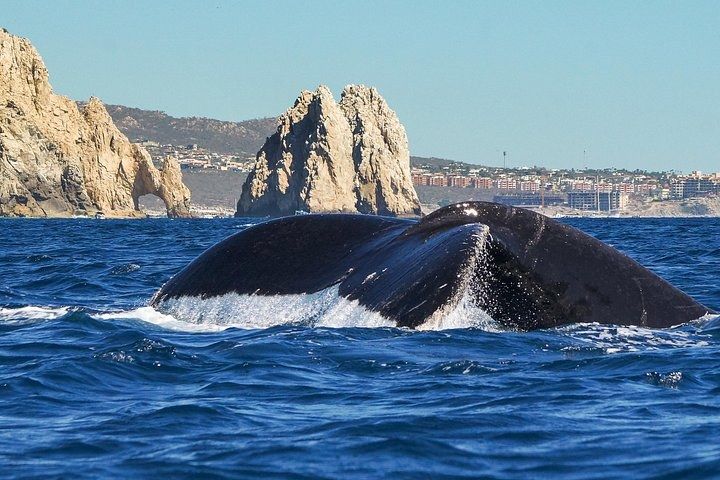
Land's End is the last granite on the peninsula, a grey finger of rock that runs off the sand and ends in the water at the southern tip of Baja California Sur. The Arch is cut through the final block of it, right where the Pacific and the Sea of Cortez meet. From a boat you hold it in profile for a minute or two, then the rock closes up again as you work around the point.
Neptune's Finger stands clear of the main spine on the Pacific side, a single pinnacle with open ocean behind it. Pelican Rock sits inside the bay, lower and paler and much closer to the sand. The two beaches share one neck of rock: Lovers Beach faces the bay and the Sea of Cortez, Divorce Beach faces the Pacific, and from the deck the difference in the water between them is obvious.
- The Arch, at the outer tip of Land's End
- Neptune's Finger, the pinnacle on the Pacific side
- Pelican Rock, inside the bay and close to the sand
- The sea lion haul-out on the low ledges at the point
- Lovers Beach on the Sea of Cortez side, Divorce Beach facing the Pacific
The Land's End sea lion colony and the birds on the rock
Sea lions haul out on the shelves at the base of the point, on the sheltered side, where the rock steps up just above the waterline. Usually you hear them before anyone points them out. Others work the same stretch in the water and surface around the boat while it idles.
Pelicans fish the shallow water between Pelican Rock and the beach, dropping from a few metres up. Frigatebirds hang on the updraft along the cliff face with barely a wingbeat. Shoot with the light coming over your shoulder. For distance, the National Park Service benchmark for wildlife on land is to stay at least 75 feet, or 23 metres, away and to move off yourself if an animal comes closer.
The protected area these rocks sit inside
The Arch, the pinnacles and the two beaches all stand inside one federal protected area, the Área de Protección de Flora y Fauna Cabo San Lucas: 208.05 hectares of it is the land you photograph and 3,787.99 hectares is the water the boat crosses, 3,996.04 hectares together. That is a small piece of federal protected water, which is part of why boat traffic at the point is regulated as closely as it is.
The CONANP record gives the first decree as 29 November 1973 and the recategorization as a Flora and Fauna Protection Area as 7 June 2000. The sand falls below the point and the water around them carry a different designation date on the municipal tourism page, 9 August 1973. The two sources give different dates, so read them as separate records rather than one.
Running a whale-watching trip in the water around these rocks requires a SEMARNAT authorization for non-extractive use of wildlife, and the boat you step onto should be carrying its official identifying marker in plain view. Each authorized company also gets a new flag from SEMARNAT every season, numbered in the bottom right corner for the year and flown while whale watching. That flag is checkable while you are still standing on the pontoon, so look for it then.
Why no boat parks at the Arch to wait for whales
The 2026-2027 federal notice takes the water nearest the landmarks out of use for whale observation. The notice was signed in Mexico City on 22 October 2026 and covers 15 December 2026 to 30 April 2027 in the Cabo San Lucas area, and the two pieces it cuts out of the protected-area polygon sit over the scenery itself: the northern section inside the port precinct, taking in 2 kilometres around the Arch of Cabo San Lucas, and a 1-kilometre band along the eastern boundary running seaward from Punta Ballenas.
On the water that gives you a two-part trip. Land's End and the Arch are a slow sightseeing pass at the start or the end, and the whale search happens beyond that circle, in the rest of the polygon. A skipper who pulls away from the Arch after a few minutes is doing the job correctly.
Once the boat is out past the closed circle it enters the observation area at about 2 knots and stays under 5 knots inside it, standing roughly 60 to 80 metres off the animal depending on vessel size. That is why the rocks go by faster than the whales do: much of the rest of the trip is spent holding position and reading the surface for a blow. Book on the strength of the whale search and take the rocks as the bookend; a cruise charging a premium for whales at El Arco is selling you water where the activity is restricted.
| Zone | What the 2026-2027 notice says |
|---|
| Northern part of the protected-area polygon, inside the port precinct | Whale watching restricted, including a 2-kilometre zone around the Arch of Cabo San Lucas |
|---|
| Eastern boundary of the polygon | A 1-kilometre strip running seaward from Punta Ballenas, restricted |
|---|
| The rest of the Área de Protección de Flora y Fauna Cabo San Lucas | Authorized observation area, 15 December 2026 to 30 April 2027 |
|---|
| Cabo Pulmo-Los Frailes, the other authorized area in the municipality | A 3.5-kilometre coastal strip closed to whale-watching boats |
|---|
The 2-hour cruise to the Arch
The short luxury format pairs the landmark pass at Land's End with the whale search outside the closed circle: 2 hours, from $95, a crewed catamaran capped at 16 travellers and a live guide in English.
★ 4.6/5 · 151 reviews
The water on either side of the point
The bay side is the sheltered one. Winter wind at the cape comes out of the north-northwest, averaging 341 degrees in December, 340 in January and 329 in February, at a mean of about 3.9 m/s at 10 metres, which leaves the Pelican Rock and Lovers Beach side of the neck in the lee while the Pacific face takes it head on. Peaks in winter reach roughly 10 to 12 m/s, and on those days the contrast between the two beaches is at its sharpest.
Water temperature is the number to check before you count on getting in. Satellite values for the water off the point came in at 23.5 C on 15 February 2026 against 19.9 C on 15 February 2025, and 23.4 C by 15 March 2026. In a cool year a swim stays short.
Snorkelling and whale observation do not share the same part of a trip. For as long as a boat is observing whales, Mexican rules shut down swimming, diving, fishing, water-skiing and parasailing alike, and no trip in Cabo may put a swimmer in the water with a whale. The 2-hour cruise to the Arch lists life jackets and safety equipment among its inclusions rather than snorkel gear, so put any Lovers Beach snorkelling on another day and keep the boat morning for the whales.
Which trip to book for the Arch and the whales
The Luxury Whale Watch Cruise to The Arch Los Cabos is the trip built around this stretch of rock: 2 hours, from $95, rated 4.6 ★ (151 reviews), a crewed luxury catamaran with no more than 16 travellers aboard, a live guide in English, an open bar (18 is the legal drinking age in Mexico) and life jackets and safety equipment. Guests at Quivira, Hard Rock, Rancho Grand Solmar and Nobu arrange their own transport, and the dock fee sits outside the price as well.
Trading a close look at the rock for whale song points you to the 2.5-hour Cabo San Lucas Luxury Catamaran Whale Watching, from $129 and rated 4.9 ★ (2294 reviews), which carries a hydrophone on board and includes snacks and alcoholic beverages; its round-trip transportation fee is settled at check-in and the dock entrance fee is left out. An engine may legally be shut off during observation only while a hydrophone is in use, so that piece of equipment is what decides whether you hear singing or a motor in neutral.
Either way, go on the earliest departure you can get. The official Los Cabos tourism board's position is that early trips find calmer water and softer light, and a flat surface is what lets you pick out a bushy blow 10 to 16 feet high from 60 to 80 metres away. Keep an afternoon slot in reserve.
- Arch and Land's End as the priority: the 2-hour cruise to the Arch, from $95
- Whale song as the priority: the 2.5-hour catamaran with a hydrophone, from $129
- Dates in early December or late April: check the current federal notice first, because for 2026-2027 this area is authorized through 30 April 2027
Questions people ask
Which whales will I see once the boat is past the point?
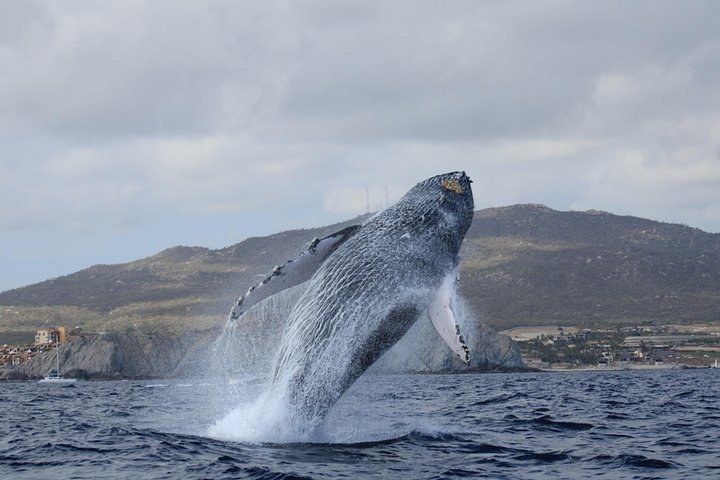
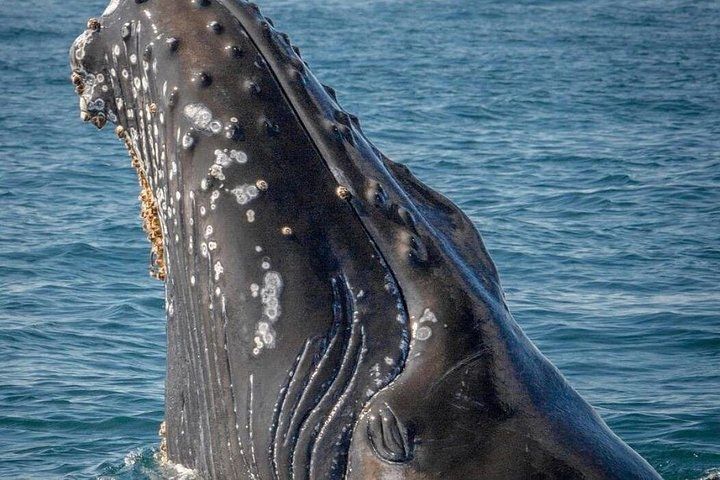
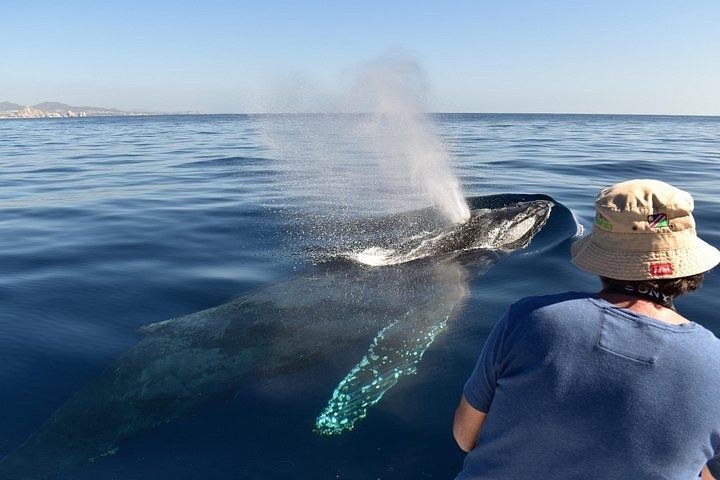
Out past Land's End, humpbacks and gray whales account for most of what gets seen off Los Cabos, while blue, fin and orca sightings turn up far less often. Mexican waters hold at least nine whale species in total, every one of them on SEMARNAT's list of species at risk. On a two-hour departure from the cape, expect humpbacks.
Can you swim with the whales at Land's End?
No. Observation rules close off swimming, diving, fishing, water-skiing and parasailing for as long as whales are being watched, and putting a swimmer in the water with a whale is illegal in Cabo. The one in-water cetacean exception in the state is orcas at La Ventana, authorized as a pilot scheme with a ceiling of 24 boats a day, and getting there is at least a six-hour commitment from Los Cabos. Snorkelling with whale sharks happens at La Paz instead, on a season of its own from October through May.
Does the Arch cruise count as a whale-watching trip in early December?
For the 2026-2027 season the authorization for the Cabo San Lucas area starts on 15 December 2026 and runs to 30 April 2027, under the notice signed on 22 October 2026. If your dates fall earlier in December, an outing past the Arch is sightseeing, so price it that way and treat a blow as luck. A new notice resets the dates each autumn, so check the current one.
Is the dock fee included in the cruise to the Arch?
The dock fee is not included, and neither is transport from Quivira, Hard Rock, Rancho Grand Solmar or Nobu. On the 2.5-hour catamaran the round-trip transportation fee is settled at check-in and the dock entrance fee is not included either. Re-verify what you owe at check-in for this season, because the port tariff schedule at Cabo San Lucas Marina was changed in October 2026.
Morning or late afternoon for the Arch and Land's End?
Morning, unless photographs are the whole point. The official tourism board's line is that an early boat gets calmer seas and softer light, with the warmest low light on the sunset departures. December afternoons are short around the point: on 15 December sunset falls at 17:37 and civil twilight ends at 18:02, while by 15 February sunset holds until 18:16 with twilight to 18:39.
Read also