In shortZodiac vs catamaran whale watching in Cabo turns on twenty metres and a roof. Under NOM-131 a hull below 10 metres holds 60 metres off a humpback and a medium or large vessel holds 80 metres, so permitted boats in Los Cabos work somewhere between 60 and 80. The inflatable puts you at water level and in the spray; the catamaran gives shade, steady footing and 2.5 hours.
60 mMinimum for hulls under 10 m
80 mMinimum for medium or large boats
30 minutesMaximum with one whale
2 to 2.5 hoursTime on the water
Zodiac vs catamaran whale watching in Cabo: what actually differs
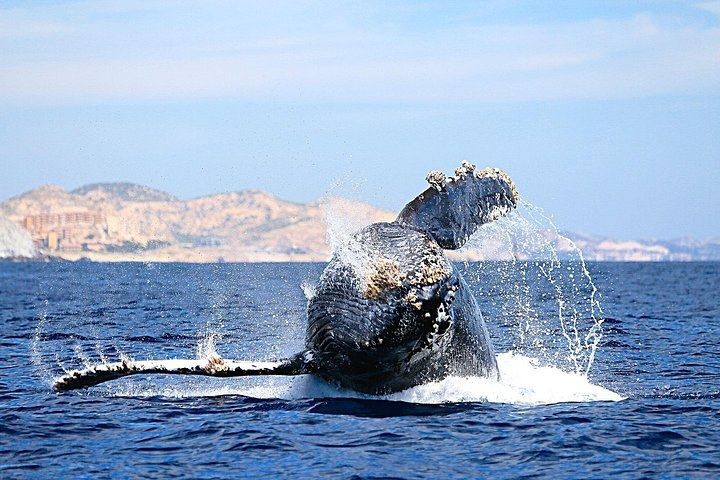
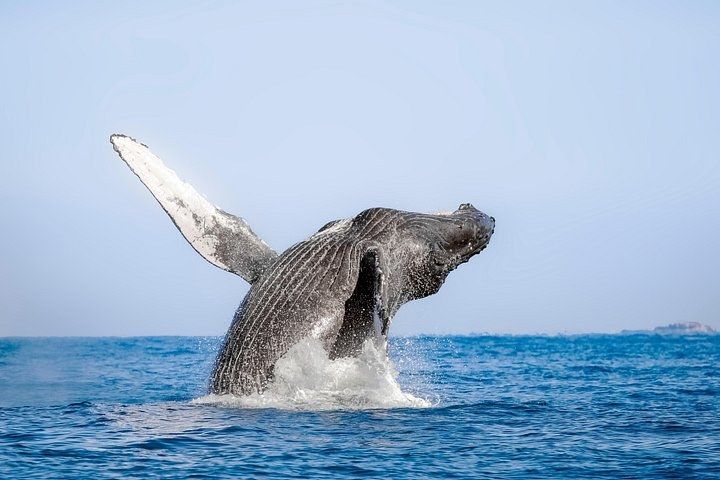
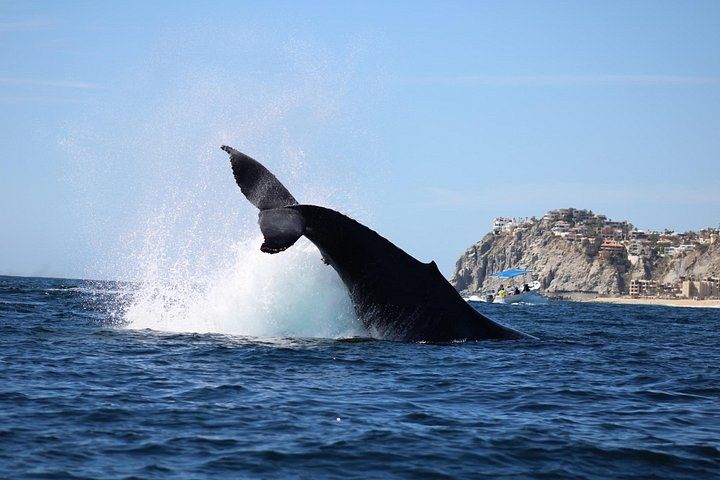
Hull size decides how close you can legally get. NOM-131-SEMARNAT-2010 puts the floor at 60 metres from a humpback for boats under 10 metres and 80 metres for medium or large vessels, and a permitted boat in Los Cabos ends up working somewhere in that 60 to 80 metre band according to its size. An inflatable therefore has twenty metres on a big catamaran, plus a seat barely above the surface, which is why a raised tail with flukes up to 18 feet across looks enormous from one and merely large from a high deck.
The rest of the rulebook applies to both hulls. Four boats at most may stay around the same whale or group, the turn ends after 30 minutes, anyone waiting holds 240 metres back, speed inside the observation area stays under 5 knots with about 2 knots on entry, and a travelling animal is taken on a diagonal from its rear quarter, parallel to its course. A faster hull buys you a shorter transit and nothing else.
Engines go quiet for one reason, which is the hydrophone. While observing, the engine must stay running in neutral when the whale is still, and it may be switched off only to listen through a hydrophone, so any format carrying one can give you the song instead of the sound of an idling motor. Among the tours on this site, the 2.5-hour catamaran and the 2.5-hour small-group trip both list a hydrophone on board.
The catamaran side of the comparison
When your party needs shade, stable footing and something to eat and drink across 2.5 hours, this is the format that also keeps a hydrophone on board.
★ 4.9/5 · 2,294 reviews
Ride, shade and seating, format by format
A Zodiac trip in Cabo San Lucas means sitting on the tube of a rigid inflatable, low and open, taking spray on the way out and on the way back. One licensed operator runs both formats and its own descriptions lay out the trade: a 2-hour rigid-inflatable speedboat with hydrophones and no restroom on board, or a 2.5-hour catamaran with appetizers, open bar and shade. Another licensed operator sets a minimum age of five on its Zodiac trip and excludes pregnant guests and anyone with heart, back or neck problems, so that format is out for part of most family groups before comfort comes into it.
Fast shaded group boats sit between the two extremes: a canopy, bench seating and a hull small enough to use the 60-metre floor. Operators in this class run several departures a day from marina offices, so the early slot is bookable, and the official Los Cabos tourism board advises exactly that, since early tours bring calmer seas and softer light. Both help when the crew is holding position and reading the surface for a bushy blow 10 to 16 feet high.
Sailing catamarans and private yachts give you the longest trip and the smallest crowd. Private whale-watching charters run 3 hours from Dock F in the Cabo Marina on vessels from 38 to 51 feet, so you get more time, your own deck and room to set up a camera. Sails are for the transit; inside the observation area the speed caps apply and the engine has to be available for the approach, so the boat behaves like any other once whales are found.
Larger cruise-style catamarans have open decks, proper shade and something solid to hold on to. The 2.5-hour luxury catamaran on this site carries a hydrophone and includes snacks and alcoholic beverages; the round-trip transportation fee is paid at check-in and the dock entrance fee is not included. The hull sits in the medium or large class, so expect the 80-metre floor rather than 60, and remember that the CDC counts alcohol among the things that increase motion sickness.
A restroom on board is the detail that settles most bookings. Of the tours on this site, the 2.5-hour Small-Group Whale Watch with Marine Biologist is the one that states a restroom on board; the Zodiac trip with a marine biologist states that it has none. If anyone in your party cannot sit out two hours without one, that single line in the tour details makes the decision for you.
Matching a boat type to your party
Default to a small purpose-built whale boat with a hydrophone. It uses the tighter 60-metre approach, the group stays small around the listening gear, and the crew can legally cut the engine while a male sings. Choose the catamaran when somebody needs shade for the full 2.5 hours, stable footing, food and drink aboard, or when you are travelling with a young child, since the inflatable formats set age minimums anyway. Take a private charter if you want the deck to yourselves for photography, or a group large enough to fill it.
Read the table one row at a time, starting with whoever in your party has the strictest requirement. Let that person choose the boat and work outward from there.
| Format | Duration | Deck, shade and ride | Restroom | Guiding and listening | Suits |
|---|
| Cabo San Lucas Luxury Catamaran Whale Watching, from $129, 4.9 ★ (2294 reviews) | 2.5 h | Open decks with shade, steady footing | Not stated in the tour details | Hydrophone on board | Shade, snacks and alcoholic beverages, mixed-age groups |
|---|
| Small-Group Whale Watch with Marine Biologist, from $109, 4.9 ★ (1256 reviews) | 2.5 h | Small group, open boat | Restroom on board | Marine biologist and hydrophone | Fewer people, a restroom, the guide's photos at no extra charge |
|---|
| Humpback Whale Watching Tour in Cabo San Lucas, from $99, 4.9 ★ (1065 reviews) | 2.5 h | Boat ride, shade not stated | Not stated in the tour details | Marine biologist guide | A focused humpback search, with bottled water and marine park fees included |
|---|
| Private sailing charter, 38 to 51 feet, Dock F in the Cabo Marina | 3 h | Private deck, sail on transit | Not stated | Not stated | Groups who want the boat to themselves and time for photography |
|---|
| Glass-bottom or panoramic sightseeing run past the Arch, Lovers Beach and Pelican Rock | 2.5 h | Open sightseeing boat | Not stated | Not stated | Scenery at Land's End; whale watching is restricted within 2 km of the Arch |
|---|
| Rigid inflatable or Zodiac, as sold by the licensed operator | 2 h | Low tube seating, no roof, spray | No restroom on board | Hydrophones on board | Adults and older children; one operator sets a minimum age of five with pregnancy and heart, back or neck exclusions |
|---|
Motion sickness, children and older travellers on board
Boat choice changes how much motion you feel and where you are allowed to stand. On a catamaran you can place yourself amidships with a clear view of the horizon; on an open inflatable you sit near the bow on a hull that slams, with no shade and little room to move. The CDC's advice covers most of what helps, and none of it needs a pharmacy.
Age matters more than anything else on the list. Children between 7 and 12 are the most affected group, susceptibility falls away through adulthood, and toddlers under two usually feel nothing at all. Surveys report women as more susceptible than men, though the CDC notes that effect is far smaller than age, and short sleep makes symptoms worse, which is an argument for an early night before an early departure rather than for skipping the morning slot.
How much of the breeze reaches you is a function of the hull you picked. Mean speed at 10 metres near the cape holds around 3.9 m/s from December through February, rises to 4.1 m/s in March and 4.3 m/s in April, blowing out of the north-northwest. On a shaded catamaran that difference barely registers. On an open inflatable in April you come back wet.
- Keep a visual horizon reference, which has been shown to give some protection against motion sickness
- Stay out of the area of maximum motion, such as the bow, and align your posture with the boat's movement
- Limit head movements, and leave reading and close visual scanning alone while under way
- Skip alcohol and smoking, both of which increase motion sickness
- Let fresh air hit your face, which an open boat does for you anyway, and fall back on music or a pleasant scent as a distraction; noticing smells more than usual is part of the problem, not a separate one
- Habituation beats any medication, though it builds slowly, so a second trip usually feels better than the first
Glass bottom boat whale watching in Cabo, jet skis and paddle craft
Glass-bottom and panoramic boats are built for the rock at Land's End. Those hulls also work water where the activity itself is restricted: the notice in force for 2026-2027 pulls whale watching out of the northern section of the protected-area polygon inside the port precinct, a band that takes in 2 kilometres around the Arch of Cabo San Lucas, and out of a 1-kilometre strip along the polygon's eastern edge running seaward from Punta Ballenas. The sightseeing runs past the Arch, Lovers Beach and Pelican Rock therefore treat whales as luck rather than the point.
A boat with no whale-watching authorization is also held much further off, about 800 feet, so it physically cannot deliver what a permitted hull can. Before you pay, look for the authorization and the official identifying marker that authorized boats must display in a visible place: SEMARNAT issues each authorized company a new flag every season, numbered in the bottom right corner for the year, and it has to be flown the whole time the boat is whale watching. The briefing on required passenger behaviour at the start of the trip is a legal requirement too, so note whether you get one.
Some craft are barred from the activity outright, whatever the conditions look like.
- Jet skis, kayaks, canoes and paddle-powered inflatables are not boat types you can choose between here: none of them may be used for whale watching
- Submersibles, ultralights and helicopters are also out in authorized zones
- Locating whales with sonar or echo sounders is prohibited, on any hull
- Once observation is under way, nobody on board fishes, dives, swims, water-skis or parasails
- No boat may position itself between a mother and calf, or approach whales that are mating or giving birth
Questions people ask
Which boat type is best for hearing whale song?
Any format carrying a hydrophone, because the engine may be switched off only while one is in use. A complete humpback song runs 7 to 30 minutes and singers stay more or less in one spot while they perform, so a stationary boat with the engine off is the setup that lets you follow a full theme. The 2.5-hour catamaran and the 2.5-hour small-group trip both list a hydrophone on board.
Do sailing catamarans actually sail while watching whales?
Only on the way out and back. Inside the observation area speed stays under 5 knots, boats enter at about 2 knots, and the engine has to idle in neutral while a whale is still, so the approach is made under power on any hull. Private charters in Cabo run 3 hours from Dock F in the Cabo Marina on vessels from 38 to 51 feet, which mainly buys you time and space rather than a different encounter.
Is there a restroom on the whale-watching boats?
It depends entirely on the format, and the tour details are where it is stated. The 2.5-hour Small-Group Whale Watch with Marine Biologist lists a restroom on board; the 2-hour rigid-inflatable format states that it has none. Plan for 2 to 2.5 hours on the water with no stop, and let that drive the booking if anyone in your group needs one.
Does the boat change what I can photograph?
The distance barely changes, since a permitted boat works at roughly 60 to 80 metres depending on its size, so bring reach whatever you board. A low inflatable gives you a water-level angle on a blow; a catamaran gives height, a rail to steady on and room to turn. Whichever deck you end up on, set Shutter Priority at 1/1000 second with ISO on Auto, switch to a high burst rate before you leave the dock, and work with the sun at your back.
Can any boat type take me swimming with whales in Cabo?
No. Swimming and diving are prohibited during whale observation, and swimming with whales is illegal in Cabo whatever hull you are on. Baja California Sur did legalize in-water orca encounters at La Ventana only, under a pilot scheme capped at 24 boats a day and at least a six-hour commitment from Los Cabos, and the status of that authorization is worth checking for your own dates.
Read also