In shortWhale watching in Mexico requires a SEMARNAT authorization, a visible official marker and a numbered seasonal flag. NOM-131-SEMARNAT-2010 sets the minimum distance by species and vessel size: at least 60 m from a humpback for boats under 10 m, 80 m for medium or large ones. Four boats maximum, 30 minutes maximum, 240 m while waiting, under 5 knots inside the area.
60 to 80 mpermitted boat to whale
240 mdistance while waiting
4 boatsmaximum around one whale
30 minutescap on one group
The authorization and the numbered season flag
Nobody may offer whale watching in Mexico without first obtaining an authorization from SEMARNAT for non-extractive use of wildlife. That paperwork is the base layer, and it is not the part you see. What you can see is the official identifying marker an authorized boat has to carry in a visible place for the whole time it is providing the service.
In practice the marker that matters to a passenger is the flag. Each season brings a new one: SEMARNAT hands a fresh flag to every authorized company, numbered in the bottom right corner for the year it covers, and the boat has to fly it the entire time it is working with whales. Read that number in the corner and match it against the season you are travelling in.
Before the boat leaves the dock the standard puts one more duty on the operator: passengers get told how they are required to behave, and the rules have to be posted on visible signage. If you board, cast off and nobody says a word about distance or behaviour, an obligation written into the standard has already been skipped.
Minimum distance from whales in Mexico, by species and boat size
NOM-131-SEMARNAT-2010 fixes a minimum observation distance between any vessel and a whale or group of whales, and it is deliberately not one single number. The figure moves with the species and with the size of the boat. For humpbacks, the animals most visitors at the cape are looking at, a small boat under 10 metres has to hold at least 60 metres and a medium or large vessel at least 80 metres.
At Los Cabos that works out to roughly 60 to 80 metres between a permitted boat and the whale, depending on the hull you are standing on. Close enough to follow a blow and a raised tail with the naked eye, and far enough that a mid-range zoom is worth carrying.
The gap between a permitted and an unpermitted boat is the whole argument for checking the authorization first. A boat without a whale-watching permit must stay about 800 feet off the animals, which is well outside the view that any cheap unauthorized ride would be advertising to you.
| Vessel | Distance it must keep |
|---|
| Small boat, under 10 m | At least 60 m from a humpback |
|---|
| Medium or large vessel | At least 80 m from a humpback |
|---|
| Any boat waiting its turn | 240 m from the whale or group |
|---|
| Boat with no whale-watching permit | About 800 feet |
|---|
Four boats, 30 minutes and the speed inside the zone
Four is the cap on boats around one whale or one group at any moment, and your boat's clock on that group stops at 30 minutes. Vessels that are not the ones observing hold 240 metres from the animals while they wait for a slot, which is why a well-run trip includes stretches of sitting still some way off.
Speed is capped twice. Inside an observation area the maximum is under 5 knots (9 km/h), and on entering the observation zone a boat comes down to about 2 knots (4 km/h). You feel both: the engine note drops long before you are anywhere near the whale.
Approach geometry is written into the standard as well. A travelling whale may be approached only on a diagonal line, from the rear quarter, parallel to the course it is already swimming. A boat pointing at a whale head-on is not doing it correctly.
While observing, the engine must be kept running in neutral when the whale is not moving. There is one permitted exception: the engine may be switched off to use a hydrophone and listen to whale song. That clause is why hydrophone boats are worth booking: with the engine off, you actually hear the whales. Ask whether the operator carries one before you pay.
The hydrophone boat, small group
Because a crew may only cut the engine when a hydrophone is in use, this 2.5-hour small-group trip from $109, rated 4.9 ★ (1256 reviews), is the one configuration that can give you a whale's song instead of an engine in neutral.
★ 4.9/5 · 1,256 reviews
What is forbidden around a whale
The list of prohibitions is short and it closes off most of what visitors ask about. Fishing, diving, swimming, water-skiing and parasailing are all prohibited during whale observation, so no lawful trip at Cabo puts a passenger in the water with a whale. Locating whales with sonar or echo-sounding equipment is prohibited too; the crew works by eye, from the surface.
Two rules exist specifically for the animals that draw people to the wintering grounds. Putting the hull between a mother and her calf is prohibited, as is any approach to whales that are mating or giving birth. Harassing, harming or feeding whales is prohibited in all cases. Those limits cover at least nine whale species living in Mexican waters, every one of them classified by SEMARNAT as a species at risk.
- No swimming, diving, fishing, water-skiing or parasailing during observation
- No jet skis, kayaks, canoes or paddle-powered inflatables used for whale watching
- No observation from submersibles, ultralights or helicopters in the authorised zones
- Sonar and echo-sounding equipment ruled out as a way of locating whales
- No positioning the boat between a mother and her calf
- No approach to whales that are mating or calving
Whale watching rules in Mexico: the distance and permit checks before you pay
Two questions before money changes hands: does the operator hold the SEMARNAT authorization, and does the boat fly this season's flag with the year number in the bottom right corner. On the water, judge the trip by things you can count rather than by what the crew says about getting close: how many boats sit with one whale, how long your boat stays with that group, how far back you hold while queueing, and how slowly you enter the zone.
Take the Humpback Whale Watching Tour in Cabo San Lucas if you want those checks met without anything extra layered on top. A marine biologist is aboard to explain the distance calls, bottled water and marine park fees are covered, and the trip runs 2.5 hours, from $99, rated 4.9 ★ (1065 reviews). Hotel pickup sits outside the price and souvenir photos are a separate purchase, so arrange your own ride to the meeting office inside the Tesoro Hotel at Local A-20, beside the marina.
The clause about switching the engine off is the reason to look at the Small-Group Whale Watch with Marine Biologist in Cabo San Lucas. It carries the hydrophone that makes the silence legal, there is a restroom on board, and the guide's photos go to guests at no extra charge; 2.5 hours, from $109, rated 4.9 ★ (1256 reviews). Check in at Plaza Bonita, inside the Cabo San Lucas Marina. Transportation and gratuities are not included.
If two hours is enough time on the water, Cabo Whale Watching: Female Crew, Guaranteed Sightings, Photos runs that length, from 1,680 pesos, rated 5.0 ★ (2144 reviews). The captains and guides are biologists, digital photos of the trip are included, and the whale warranty gives you a second departure at no cost if the first one finds nothing. Give a driver or a map app the Breathless hotel as the reference point: the boat is at dock zero in front of it and the guides stand outside the dock in green shirts. The dock fee and the optional shuttle are not included.
Questions people ask
Is there a legal season for whale watching in Mexico?
Yes. A SEMARNAT notice fixes the dates and is re-issued annually; the 2026-2027 version carries a Mexico City signature dated 22 October 2026. It opens the Cabo San Lucas area to the activity on 15 December 2026 and closes it on 30 April 2027, with Cabo Pulmo National Park working to the same two dates. Check the current notice before planning dates at either end of the window.
Does the 30-minute limit mean the whole tour lasts 30 minutes?
No. The 30-minute cap is the maximum time one boat may stay around the same whale or the same group. Departures from the marina run 2 to 2.5 hours, and that time goes on searching, holding position at 240 metres while other boats take their turn, and moving between animals.
Why does the boat not look for whales right next to the Arch?
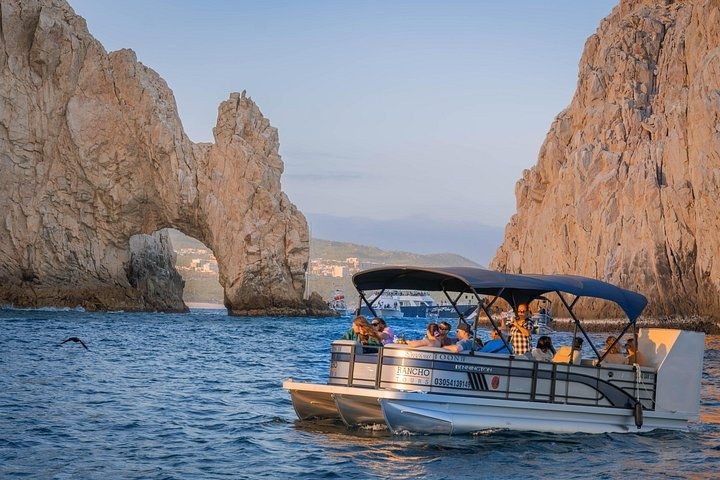
Two pieces of water are restricted by the 2026-2027 notice: the northern part of the protected-area polygon that falls inside the port precinct, with a 2-kilometre zone drawn around the Arch of Cabo San Lucas, plus a 1-kilometre strip along the eastern boundary running seaward from Punta Ballenas. Cruises that pass the Arch are showing you scenery. Searching happens in the remainder of the Área de Protección de Flora y Fauna Cabo San Lucas, out beyond those limits.
Can I swim with a whale anywhere near Cabo San Lucas?
Swimming with whales is illegal in Cabo, and swimming is one of the activities prohibited during whale observation. The single exception in the state is orcas at La Ventana: Baja California Sur legalized that before any other Mexican state, under a pilot scheme that caps boats at 24 a day, and reaching it from Los Cabos takes at least six hours. Confirm the authorization status yourself for your own dates.
Read also