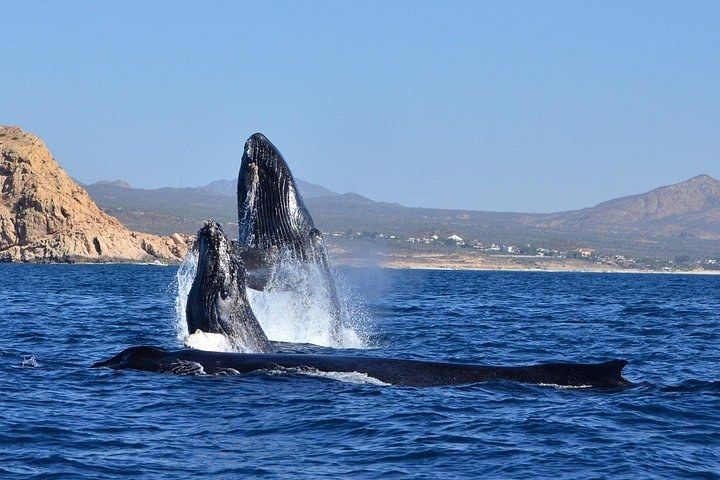
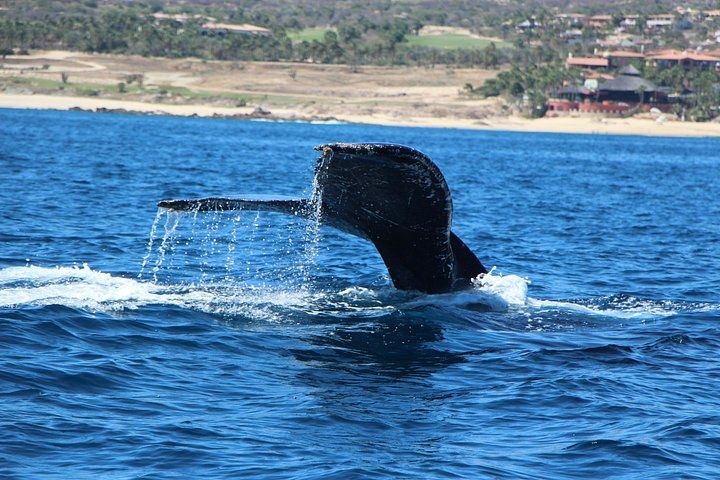
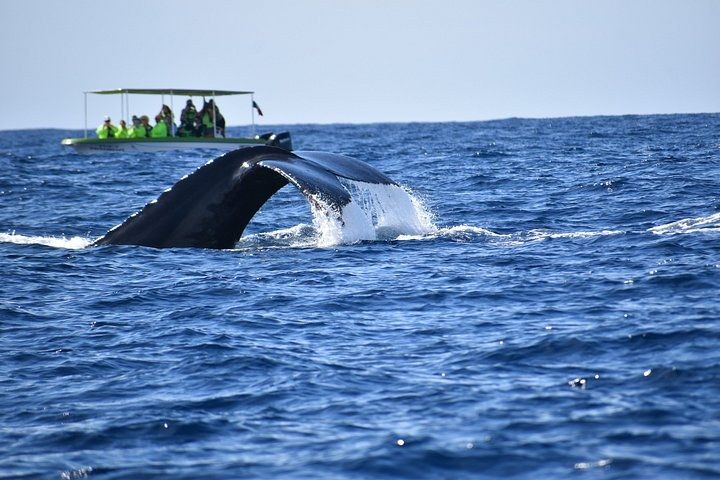
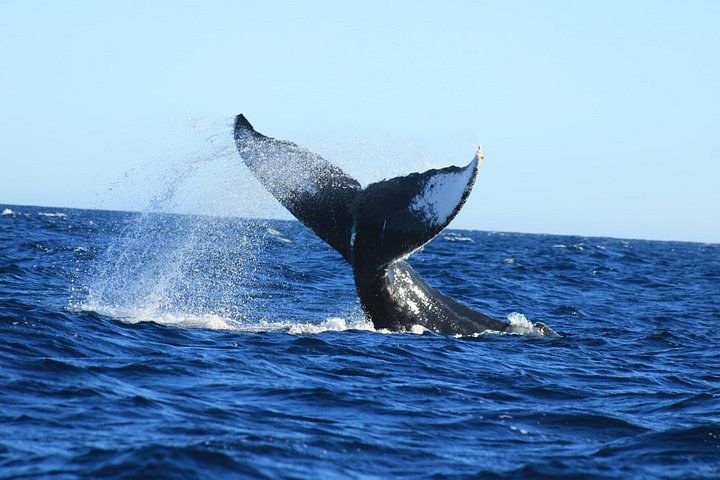
In shortOrcas in Los Cabos are a chance sighting. Humpback and gray whales are the species the cape boats commonly find, with orca, blue and fin far rarer. Mexico's declared orca observation area lies north of the cape, between El Sargento and La Ventana: 110,906.06 hectares, running 10 nautical miles past Isla Cerralvo, and at least a six-hour commitment from Los Cabos.
110,906.06 haEl Sargento-La Ventana area
10 nautical milesBeyond Isla Cerralvo
24 boats a dayLa Ventana pilot cap
6 hours minimumCommitment from Los Cabos
How often orcas turn up on a cape trip
Orca sits at the bottom of the probability list for a cape departure. In the official Los Cabos tourism board's own breakdown it sits in the rare column alongside blue and fin, with humpback and gray listed as the routine sightings. At least nine whale species live in Mexican waters, all of them classified by SEMARNAT as species at risk, so the crew works with whatever the day puts in front of the bow.
The shape of the trip is the other half of the answer. Departures from the marina run 2 to 2.5 hours inside the Cabo San Lucas Flora and Fauna Protection Area. Two closures in the 2026-2027 notice cut that polygon down further: the northern part of it inside the port precinct, with a 2-kilometre zone drawn around the Arch, and a 1-kilometre strip along the eastern boundary running seaward from Punta Ballenas. Sonar and echo sounders cannot be used to find animals, so every sighting starts with someone's eyes on a small patch of authorized water.
An orca on that trip is luck, and the crew will work the group under the same rules they apply to a humpback. Build the boat day around humpbacks in the January to March peak.
Where the orca water sits, north of the cape
The water that matters for killer whales in Baja California Sur is up the coast from the cape. The declared observation area runs off El Sargento and La Ventana, covers 110,906.06 hectares and pushes its seaward boundary 10 nautical miles past Isla Cerralvo. Set that against the 3,996.04 hectares of the protected area at Cabo San Lucas, 3,787.99 of them marine, and the gap in searchable sea explains why one coast has an orca reputation and the other does not.
No orca season is published in the way the cape has one. The dates that can be confirmed are the whale-watching dates: in the Cabo San Lucas area, which includes San Jose del Cabo, and in Cabo Pulmo National Park, the activity is authorized from 15 December 2026 to 30 April 2027 under the notice signed in Mexico City on 22 October 2026. Ask any La Ventana orca operator which authorization it is working under for your dates before you pay.
Distance is what makes this a planning question. Reaching the orca area from Los Cabos is a commitment of at least six hours, so the day goes whichever way you travel.
| Area | Size | Closures and extent | Status for whale watching |
|---|
| Area de Proteccion de Flora y Fauna Cabo San Lucas | 3,996.04 hectares, 3,787.99 marine | Northern part inside the port precinct closed, including a 2 km zone around the Arch; 1 km strip seaward from Punta Ballenas | Authorized 15 December 2026 to 30 April 2027; humpback and gray are the common sightings |
|---|
| Cabo Pulmo-Los Frailes | Park covers 7,111 hectares, roughly 99 percent marine | 3.5 km coastal strip closed to whale-watching boats | Authorized 15 December 2026 to 30 April 2027 |
|---|
| El Sargento-La Ventana observation area | 110,906.06 hectares | Extends 10 nautical miles beyond Isla Cerralvo | The declared orca area, and the only place in the state where in-water orca encounters were legalized, capped at 24 boats a day |
|---|
The cape trip to build the day around
Orcas stay a bonus, so the sensible booking is the straightforward humpback run: 2.5 hours, from $99, 4.9 ★ (1065 reviews), with a marine biologist aboard to tell you which species you are looking at, bottled water and marine park fees covered. The meeting office is inside the Tesoro Hotel, Local A-20, close to dock M-O.
★ 4.9/5 · 1,065 reviews
Swimming with orcas: what the pilot scheme allows
In-water orca encounters are legal in one place in Mexico. Baja California Sur was the first state to allow swimming with orcas, and the permission applies at La Ventana only, under a pilot scheme that caps the boats at 24 a day. Swimming with whales stays illegal at Cabo.
The cap is the figure to take seriously. Twenty-four boats a day is a thin allocation across a declared area of 110,906.06 hectares, and a pilot scheme is not a settled rule, so verify the authorization for your own dates instead of assuming it is running.
Nothing of the kind happens on a cape departure. During whale observation the prohibited list covers swimming and diving along with fishing, water-skiing and parasailing, and the small craft you might picture paddling up to a pod, jet skis, kayaks, canoes and paddle-powered inflatables, cannot be used for whale watching in the first place. A compliant Cabo trip keeps you on deck for the full 2 to 2.5 hours.
Orca behaviour you can read from the deck
Watching from a boat at legal distance means reading the surface. NOAA lists the behaviours seen most often from whale-watching boats, and they are the vocabulary your crew will use whatever species is in front of you:
- Breaching, where the body clears the water
- Spyhopping, a vertical rise with the head above the surface
- Lobtailing, slapping the surface with the tail
- Pectoral slapping with the long fins
- Logging, lying quietly at the surface
The rules are the same for a rarer animal
NOM-131-SEMARNAT-2010 sets a minimum observation distance that varies with species and vessel size, and in Los Cabos it leaves a permitted boat at roughly 60 to 80 metres from the animal depending on the hull. Four boats is the ceiling around one whale or group, the clock on that group runs out at 30 minutes, anyone queueing for a turn sits 240 metres back, the speed limit is under 5 knots inside the observation area and about 2 knots as you enter it, and a moving animal is taken on a diagonal from its rear quarter, parallel to the course it is already swimming.
Two limits apply when young animals are around. Putting the hull between a mother and her calf is forbidden, and so is approaching animals that are mating or giving birth. While observing, the engine stays running in neutral when the animal is still, and it may be switched off only to use a hydrophone, which is the one setup that gives you a quiet boat.
You can check compliance before you leave the dock. A SEMARNAT authorization for non-extractive use of wildlife comes before anyone can sell whale watching at all; the vessel then carries an official identifying marker somewhere you can see it, SEMARNAT hands each authorized company a new flag every season with a number in the bottom right corner for the year, and the briefing on required behaviour plus the rules on signage are both on the operator at the start of every trip.
Whether to give up a day for the orca area
Keep orcas as the bonus. Build the boat day at the cape around humpbacks, aim at the January to March peak and take the first morning departure, since the tourism board's own advice is that early trips bring calmer seas and softer light. Calm water helps when the hull has to hold 60 to 80 metres off an animal while the crew scans for the next blow.
Give up a whole day only if being in the water with orcas is the point of the holiday. That means La Ventana as the one authorized location, a minimum six-hour commitment from Los Cabos, a ceiling of 24 boats a day and a pilot authorization whose current status you confirm yourself. Treat it as an extra day, because the two trips put you with different animals on different water.
No official sighting statistics are published for Cabo San Lucas, so any percentage quoted at you for orcas or anything else is marketing. What you can hold an operator to is a written offer of a second trip at no cost if no whales are found, and that only helps if you book early in your stay rather than on your last morning.
Questions people ask
Is there a separate orca season at Cabo San Lucas?
The federal notice sets a single authorized whale-watching period for the Cabo San Lucas area, and this season it runs from 15 December 2026 to 30 April 2027. That window says nothing about which species you will meet. Orca falls in the far rarer group with blue and fin whales, while humpback and gray are what the cape boats commonly find.
Can a captain go looking for orcas with sonar or a jet ski?
No. Locating whales with sonar or an echo sounder is prohibited, and a jet ski is not a legal platform for whale watching inside the authorised zones, nor is a kayak, a canoe or a paddle-powered inflatable. Spotting is done by eye from a permitted vessel flying the SEMARNAT flag for the current season.
What happens if we meet orcas while the boat is watching a humpback?
The same numbers apply. Observation of one whale or group ends at 30 minutes, no more than four boats may stay around that group, anyone waiting their turn holds 240 metres, and the boat works at roughly 60 to 80 metres depending on its size. A boat with no whale-watching permit has to stay about 800 feet off, which is why an unauthorized cheap ride cannot deliver what it advertises.
Can I get in the water with an orca, or any whale, from Los Cabos?
Not with whales at the cape, where swimming during whale observation is prohibited. The one place the state legalized in-water orca encounters is La Ventana, through a pilot scheme that lets 24 boats a day work the area, and reaching it from Los Cabos takes six hours at minimum. Swimming with whale sharks is a separate La Paz activity, with its own season from October through May, boats capped at 36 feet, groups of five, and a record of being suspended mid-season.
Is a trip up to the orca area worth doing instead of a Cabo boat tour?
Only if the in-water orca encounter is the reason for the trip. The orca area off El Sargento and La Ventana covers 110,906.06 hectares and reaches 10 nautical miles beyond Isla Cerralvo, but getting there costs at least six hours from Los Cabos and the daily boat allocation is capped. A cape departure is 2 to 2.5 hours and puts you with the humpbacks that winter here.
Read also