In shortHumpbacks can be watched off Cabo San Lucas only on the dates the federal notice allows, which this season means 15 December 2026 to 30 April 2027; the thickest humpback months inside that window run from January to March. Humpbacks winter off the cape to breed and calve, so expect bushy blows, breaching, pectoral and tail slapping, spy-hopping and newborns alongside their mothers. Permitted boats work from roughly 60 to 80 metres.
60 feetMaximum humpback length
18 feetWidth of the flukes
7 to 30 minutesLength of one male song
60 to 80 mPermitted approach distance
Why humpbacks winter at the southern tip of Baja
The whales in front of the cape are at the warm end of a long commute. NOAA describes the population that winters in Mexican waters as breeding along the Pacific coast and around the Revillagigedo Islands, transiting the Baja California Peninsula, and feeding anywhere between California and the Aleutian Islands. Some humpback populations cover around 5,000 miles between tropical breeding grounds and cold feeding grounds, and they do not dawdle: on the roughly 3,000-mile run between Alaska and Hawaii, some whales finish the crossing in as few as 28 days.
Everything you see from the boat follows from the fact that the cape is the breeding end of that route. The 2026 to 2027 federal notice authorizes observation in the Cabo San Lucas area from 15 December 2026 to 30 April 2027, and the official Los Cabos tourism board puts the busiest months between January and March. Of the whales reported off Los Cabos, the humpback shares the realistic list with the gray whale alone, since blue, fin and orca encounters stay rare. The humpback is also one of at least nine whale species living in Mexican waters, and SEMARNAT's at-risk listing covers all nine, this one included.
What humpbacks do at the surface off Cabo San Lucas
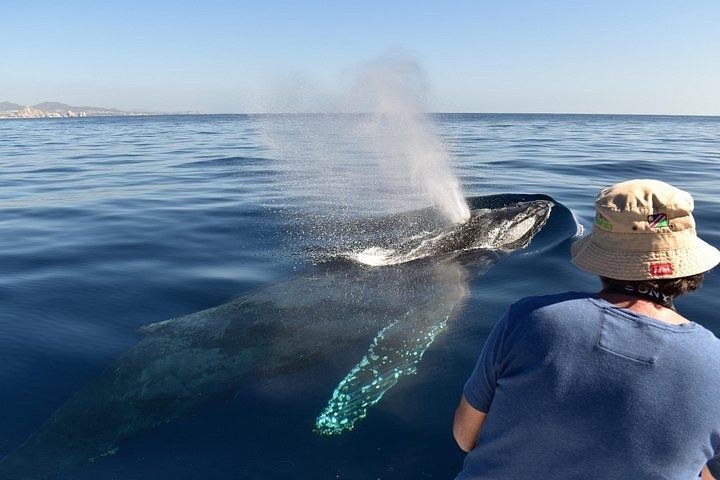
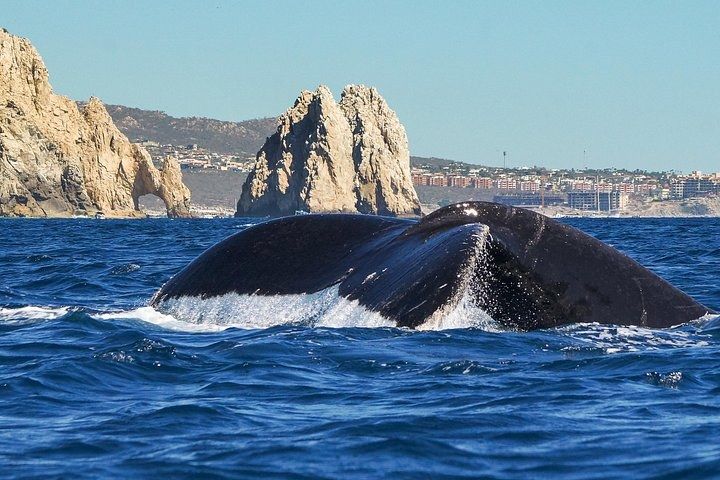
The blow comes first, bushy and standing 10 to 16 feet above the surface, usually a few seconds before anything else shows. Then the back rolls through. A whale going deep lifts its tail to vertical before it drops away, and at 18 feet across, the flukes are the part of a humpback you can read clearly from a boat holding legal distance. The animal underneath runs to about 60 feet and some 40 tons, females larger than males, and may be 80 or 90 years old.
NOAA lists the surface behaviours that whale-watching boats see most often, and all of them turn up here in winter:
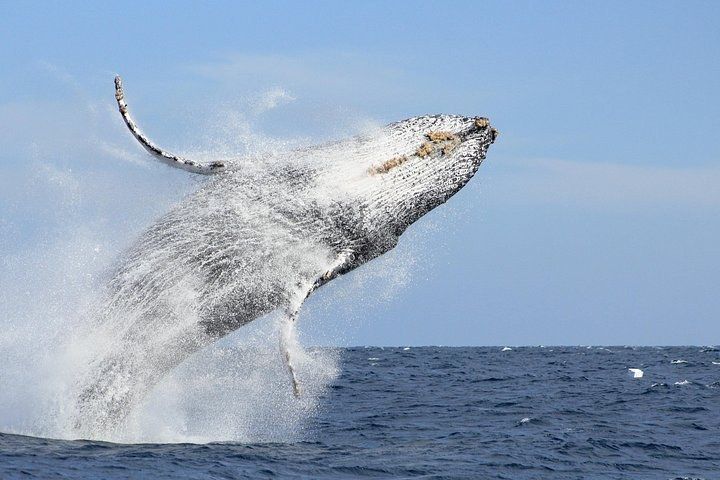
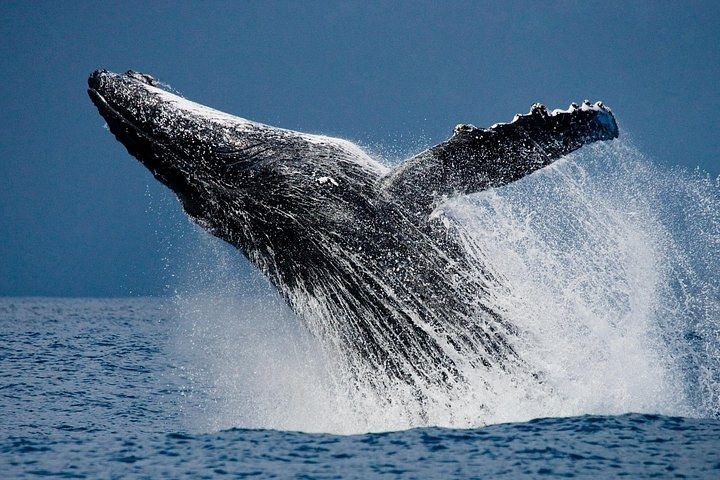
- Breaching: the whole body clears the water, and from 60 to 80 metres off, everyone on board reacts in the same instant.
- Pectoral slapping: the whale lies on its side and brings the long flipper down on the surface, often again and again.
- Lobtailing: the tail comes down flat on the water instead of being raised and held.
- Spy-hopping: the head pushes vertically clear of the surface, then sinks back.
- Logging: the whale rests quietly at the surface, which is also when the boat has to keep its engine idling in neutral.
A trip focused on the humpbacks
This 2.5-hour departure costs from $99, is rated 4.9 ★ (1065 reviews) and goes out with a marine biologist guide and marine park fees included. Check in at the Tesoro Hotel office by dock M-O.
★ 4.9/5 · 1,065 reviews
Competitive groups and the rules the captain works to
Several adults moving fast together, surfacing almost on top of one another and shoving for position, is the other scene the middle of the season can hand you. That behaviour is also where the regulations bite hardest. A group that is mating cannot be approached, and neither can a whale giving birth; once the animals are travelling, the captain has to come in on a diagonal from the rear quarter, parallel to their course, and never straight at them.
Four numbers govern the rest of the encounter. No more than four vessels may stay around the same whale or group, observation of that group ends at 30 minutes, boats waiting their turn hold 240 metres, and speed inside the observation area stays under 5 knots, dropping to about 2 knots on entry. Fishing, diving, swimming, water-skiing and parasailing are all prohibited while whales are being observed, and jet skis, kayaks, canoes and paddle-powered inflatables cannot be used for whale watching at all.
Mothers and newborns in the wintering grounds
Newborn humpbacks are in this water because they were born in it. Gestation runs 11 months and a calf measures about 13 to 16 feet at birth, big enough to pick out beside the mother even at the distance the law sets. Females produce a single calf every two to three years on average, and the calf stays alongside for up to a year before weaning.
Pairs become the ordinary sighting as the January to March peak builds, so aim at the second half of January and February if calves are the point of the trip. Two rules then shape what you get. No boat may put itself between a mother and her calf, and the approach floor depends on hull size: at least 60 metres for a boat under 10 metres, at least 80 metres for anything medium or large. Ask which size of boat you are booking, because on a calf those 20 metres change how much you can make out.
Listening to a singing male from the boat
Male humpbacks sing on the breeding grounds, and a complete song lasts 7 to 30 minutes. The structure is layered, built from themes, phrases, units and subunits, with phrases repeated before the whale moves to the next theme, and the repertoire changes from one year to the next. A singer also stays relatively stationary throughout the display, so a crew that finds one can sit with it instead of following it.
Mexican rules allow one exception to the engine staying on. The motor has to be left running in neutral for as long as the whale holds still, and the single circumstance in which a captain may shut it down is to put a hydrophone in the water and listen to the song. Without a hydrophone on board there is no legal situation in which the engine goes quiet over a singing whale, which is the thing to check when you compare the tours. Using sonar or echo sounders to find whales is prohibited, so the search itself is done by eye.
Several trips on this site carry a hydrophone, among them the Small-Group Whale Watch with Marine Biologist in Cabo San Lucas: 2.5 hours, from $109, rated 4.9 ★ (1256 reviews), with a restroom on board as well. The 2.5-hour Cabo San Lucas Luxury Catamaran Whale Watching, from $129 and rated 4.9 ★ (2294 reviews), includes snacks and alcoholic beverages.
Telling a humpback from a gray whale at a distance
Identification at 60 to 80 metres comes down to the blow and the tail. The humpback cues all have figures behind them: a bushy spout standing 10 to 16 feet up, long pectoral fins that get used noisily on the surface, and flukes up to 18 feet wide raised to vertical before a deep dive. A whale that surfaces, blows and slides under without showing a tail is giving you none of that, and the guide will usually call it before the deck has worked it out.
Gray whales are the other common species in Los Cabos, and visitors who picture touching distance are picturing the Pacific lagoons. That is a full day out of Cabo San Lucas rather than a boat ride, roughly 05:00 to 19:00, with about five hours of driving each way for up to three hours on the water. The local 2 to 2.5 hour departure is the humpback trip, and through the January to March peak humpbacks are what the boat will be working.
Picking a boat for the humpbacks
Default to the small-group biologist boat. It runs 2.5 hours, from $109, rated 4.9 ★ (1256 reviews), carries the hydrophone that permits the engine to be shut off, has a restroom on board, and the guide's photos go to guests at no extra charge. Neither transport nor gratuities sit in the price, and the boat has stopped handing out single-use plastic bottles. Check-in is at Plaza Bonita in the Cabo San Lucas Marina: look behind Starbucks if you come from the road, behind Nowhere Bar if you walk round from the marina.
Comfort is the reason to switch to the luxury catamaran. Same 2.5 hours, from $129 and rated 4.9 ★ (2294 reviews), with the hydrophone on board plus snacks and alcoholic beverages. You settle the round-trip transportation fee when you check in, and the dock entrance fee sits outside the price as well.
The trip named after the animal is the cheapest of the three: Humpback Whale Watching Tour in Cabo San Lucas, 2.5 hours, from $99, rated 4.9 ★ (1065 reviews), with a marine biologist guiding it and bottled water and the marine park fees covered. Pictures of your trip are sold as an extra, and nobody collects you from your hotel. The meeting office sits inside the Tesoro Hotel, Local A-20, right at the marina, close to dock M-O, next to the white lighthouse with the red stripe and behind the D'Right Joint restaurant.
Take the first departure of the day whichever boat you pick. The official tourism board's advice is that early trips get calmer seas and softer light, and calm water counts for a lot when the hull has to hold position 60 to 80 metres off a whale while the crew reads the surface for the next blow.
| Tour | Duration | From | Rating | Hydrophone | Best for |
|---|
| Small-Group Whale Watch with Marine Biologist | 2.5 h | $109 | 4.9 ★ (1256) | Yes | Song, small groups, restroom on board |
|---|
| Cabo San Lucas Luxury Catamaran Whale Watching | 2.5 h | $129 | 4.9 ★ (2294) | Yes | Comfort, snacks and alcoholic beverages |
|---|
| Humpback Whale Watching Tour in Cabo San Lucas | 2.5 h | $99 | 4.9 ★ (1065) | Not stated | A focused humpback trip with a biologist guide |
|---|
Questions people ask
Can I swim with humpback whales in Cabo?
No. Getting in the water with a humpback is against the law here, and the rules also shut down fishing, diving, swimming, water-skiing and parasailing for as long as whales are being observed. If swimming with a cetacean is the goal, the state allows it only with orcas at La Ventana, where a pilot scheme caps the fleet at 24 boats a day and the trip from Los Cabos takes six hours at minimum.
How many humpbacks will I see on one departure?
No official sighting statistics are published for Cabo San Lucas, so advertised success percentages come from operators and are not verified anywhere. What is fixed is the calendar: the authorization covers 15 December 2026 to 30 April 2027, and January to March is when numbers run highest. Put your boat day early in the trip so you keep spare dates in hand.
How do I check the boat is authorized to approach humpbacks?
No company can sell whale watching without a SEMARNAT authorization for non-extractive use of wildlife, and the boats that hold one display an official identifying marker where you can see it. On the dock that marker is a flag, reissued for each season and numbered in the bottom right corner for the year, kept flying the whole time the boat is out watching. The crew must also brief passengers before departure and display the rules on visible signage.
What camera settings work for a breaching humpback?
Keep the sun behind you and shoot moving wildlife in Shutter Priority at 1/1000 second with ISO set to Auto, which holds sharpness without a tripod. Set a high burst rate before you leave the dock. Take an early frame of the animal and keep shooting instead of waiting for one perfect moment.
Could I get closer on a kayak or a small unpermitted boat?
No. Watching whales from a jet ski, a kayak, a canoe or a paddle-powered inflatable is not permitted in any form. A boat without a whale-watching permit has to stay roughly 800 feet from a whale, well outside the 60 to 80 metres a permitted vessel may work from, so an unlicensed trip leaves you further off the animal.
Read also