Where the Peninsula Ends
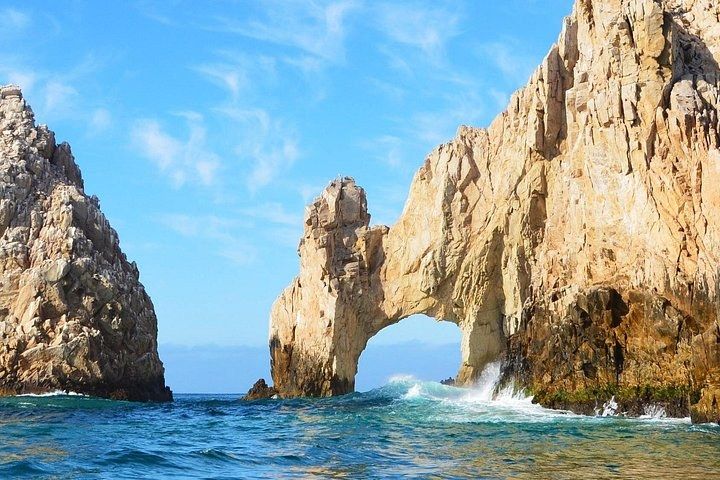
Cabo San Lucas sits at the southern end of the Baja California peninsula, where the Pacific swings around the headland into the Gulf of California. The rock at Land's End, the Arch and the sand falls underwater below them make up a short stretch of coast with deep water close inshore. Whales were using these waters in winter long before anyone drew the cape on a chart. Some humpback populations cover about 5,000 miles between cold feeding grounds and tropical breeding grounds, and the group that winters off Mexico breeds along the Pacific coast and the Revillagigedo Islands, transits the peninsula, and feeds from California to the Aleutian Islands.
Protection came early here, and it was aimed at the water. The municipal tourism office dates the designation of the cape's waters and sand falls to 9 August 1973. CONANP's own record for the site gives a first decree on 29 November 1973 and a recategorization as a Flora and Fauna Protection Area on 7 June 2000. The polygon is small for a place photographed this often: 3,996.04 hectares in all, of which 3,787.99 hectares are marine and only 208.05 hectares are land. Most of what the designation covers therefore lies offshore, reached from the marina rather than from a beach.
What Winter Brings to the Cape
The whale-watching season at Cabo San Lucas is a legal window with fixed dates. For 2026-2027 the federal notice authorizes whale watching in the Cabo San Lucas area from 15 December 2026 to 30 April 2027, and the same dates cover San Jose del Cabo and Cabo Pulmo National Park. SEMARNAT reissues the notice every year; the 2026-2027 one was signed in Mexico City on 22 October 2026. The official Los Cabos tourism board puts the window more loosely at early December to mid-April depending on the year, with the peak from January to March. Humpback and gray whales are the species most commonly seen, and blue, fin and orca sightings are far rarer.
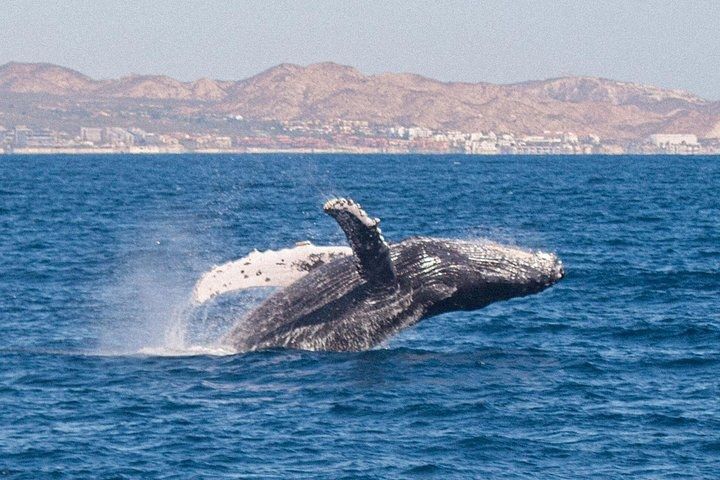
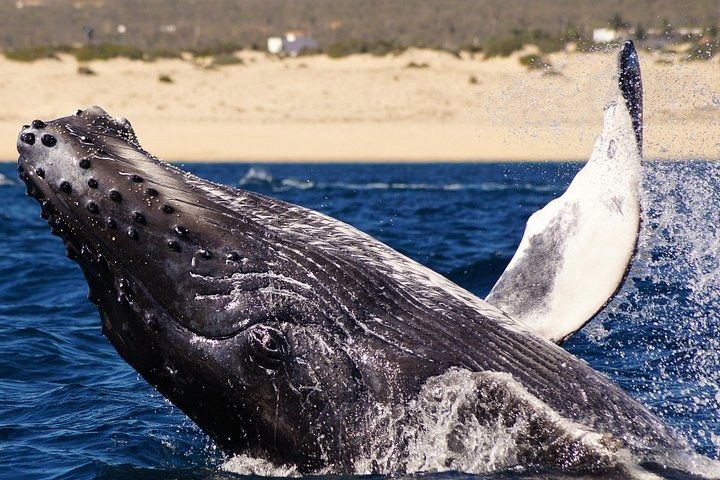
Humpbacks are the animals most trips are built around. They reach about 60 feet and up to about 40 tons, females larger than males, and live about 80 to 90 years. The blow is bushy and stands 10 to 16 feet above the water, which is usually what a captain spots first, and the flukes can be 18 feet wide, so a raised tail reads clearly even from a small boat. Calves arrive after an 11-month gestation at about 13 to 16 feet long, females produce one calf every two to three years on average, and a calf stays with its mother for up to a year. Boats may not place themselves between a mother and calf.
Male humpbacks sing on the wintering grounds, and the song has a structure: themes built from phrases, phrases from units and subunits, with a complete song running 7 to 30 minutes. Songs change from year to year, and singers stay relatively stationary throughout the display, so a singer tends to hold one patch of water. Mexican rules allow a boat to switch its engine off only to use a hydrophone, and that is the one moment when an engine goes quiet during an encounter. Above the surface, the behaviours seen most often from boats are breaching, spyhopping, lobtailing, pectoral slapping and logging.
Key Facts About Cabo San Lucas and Its Whales
1973
First decree protecting the water at the cape
3,996.04 hectares
Size of the Cabo San Lucas Flora and Fauna Protection Area
20,000 years
Approximate age of the nearby Cabo Pulmo reef
112,437 hectares
Sierra La Laguna Biosphere Reserve behind Los Cabos
5,000 miles
Migration covered by some humpback populations
60 feet
Length a humpback whale reaches
How the Protected Areas and Boat Rules Came In
The cape is one piece of a protected-area network put together between 1973 and 2000. The San Jose del Cabo Estuary became a State Ecological Reserve on 8 October 1993. The Sierra La Laguna Biosphere Reserve, the mountain block behind Los Cabos, was decreed on 6 June 1994, covers 112,437 hectares and holds 694 plant species, 79 of them endemic, along with 74 recorded bird species and 40 mammal species. Cabo Pulmo was decreed a marine national park on 6 June 1995, recategorised on 7 June 2000, with the management programme summary published on 13 November 2009; it covers 7,111 hectares, roughly 99 percent of it marine, around a reef approximately 20,000 years old.
Rules for being near a whale arrived later. Under NOM-131-SEMARNAT-2010 small boats under 10 m must stay at least 60 m from a humpback and medium or large boats at least 80 m, boats waiting their turn hold 240 metres, no more than four boats may stay around the same whale or group, and the maximum observation period is 30 minutes. Speed stays under 5 knots inside observation areas and about 2 knots on entering the zone. A travelling whale is approached only on a diagonal from the rear quarter, parallel to its course. Sonar and echo sounders may not be used to locate whales, and jet skis, kayaks, canoes and paddle-powered inflatables may not be used for whale watching at all.
Authorization is visible on the boat. Anyone offering whale watching must hold a SEMARNAT authorization for non-extractive use of wildlife, authorized vessels carry an official identifying marker in a visible place, and SEMARNAT issues each authorized company a new flag every season with a number in the bottom right corner identifying the year, flown at all times while whale watching. Before departure the operator must brief passengers on how they are required to behave and display the rules on visible signage. Swimming with whales is not part of that framework anywhere in Cabo: fishing, diving, swimming, water-skiing and parasailing are all prohibited during whale observation.
Cabo San Lucas Today
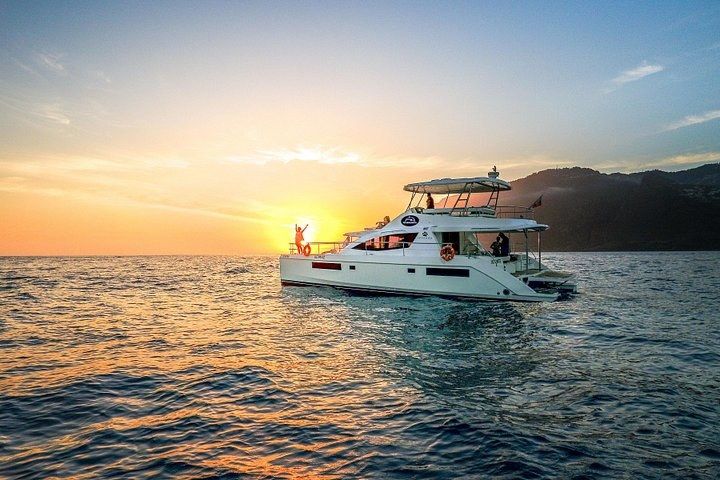
A trip today runs 2 to 2.5 hours and starts in the marina. The offices sit close together. One is inside the Tesoro Hotel at Local A-20, near dock M-O and next to the white lighthouse with a red strip. One is in Plaza Bonita, behind Starbucks from the road and behind Nowhere Bar from the marina side. One is at dock zero in front of the Breathless hotel, where guides wait outside in green shirts. For anyone staying east along the corridor, a group tour leaves from Puerto Los Cabos Marina in San Jose del Cabo, with meeting times generally 8:15 AM or 11:30 AM. The tourism board's own advice is that early departures bring calmer seas and softer light.
Winter at the cape is mild rather than hot. Mean air temperature is 22.1 C in December, 21.2 C in January, 20.9 C in February, 21.5 C in March and 22.2 C in April, with light to moderate wind out of the north-northwest. Daylight is short in midwinter, and on 15 December the sun rises at 06:53 and sets at 17:37. Mid-January to the end of February gives the best balance of whale numbers, calves and calm water. The Arch is scenery passed at the start or end of the run, since whale watching is restricted within 2 kilometres of it. Pick a boat carrying a hydrophone, take the first morning slot, and check availability for your dates.