In shortHumpback and gray whales are the two species most commonly seen off Los Cabos, and blue, fin and orca sightings are far rarer. The wider Mexican list is longer, at least nine whale species, and every name on it carries SEMARNAT's at-risk classification. On a boat out of the Cabo San Lucas marina during the January to March peak, the animal alongside you is almost always a humpback.
9+whale species in Mexican waters
60 fthumpback maximum length
18 ftwidth of humpback flukes
10-16 ftheight of a humpback blow
Which whale species you can realistically see off Cabo San Lucas
Two species carry the whole season. The official Los Cabos tourism board names humpback and gray whales as the ones most commonly seen here, and places blue, fin and orca well behind them. On a 2 to 2.5 hour departure from the marina inside the January to March peak, the whale you end up watching will nearly always be a humpback.
Count the full roster in Mexican waters and you reach at least nine whale species, each one of them listed by SEMARNAT as at risk. That status is the reason the viewing distances, the queue of boats and the time limit on a single animal exist, and it applies to the humpbacks you see on most trips and to the rare visitors alike.
| Species | How often seen off Los Cabos | When it is most likely |
|---|
| Humpback | One of the two seen most often | Across the authorized window, strongest in the January to March peak |
|---|
| Gray | One of the two seen most often | Along the coast with their young, December through April, per the tourism board |
|---|
| Blue | Far rarer | No month of the season makes it likely |
|---|
| Fin | Far rarer | Unpredictable, with no likely month |
|---|
| Orca | Far rarer at the cape | Unpredictable here; the water set aside for orca observation is up the coast |
|---|
How to recognise a humpback from the boat
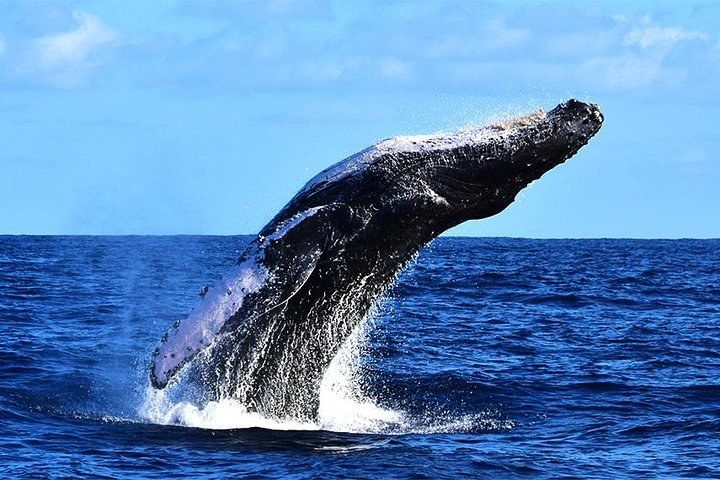
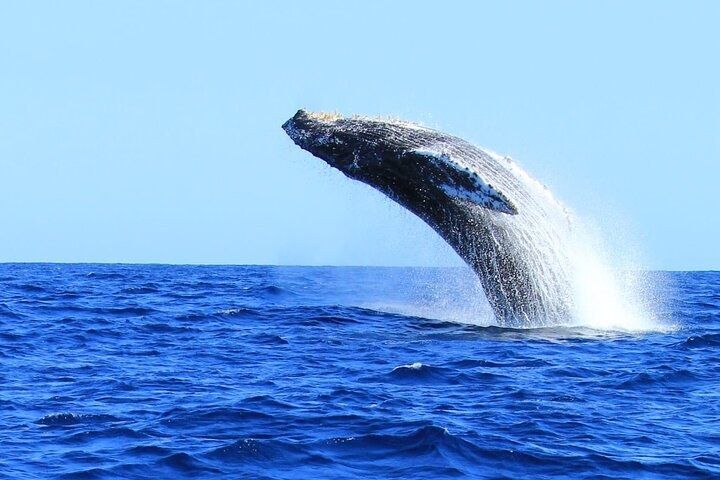
Start with the blow. At the distance a permitted boat works from, the spout is the only part of the animal big enough to read. A humpback's is bushy and 10 to 16 feet high, it hangs in the air for a moment, and the back comes up behind it. The whale itself reaches about 60 feet and up to roughly 40 tons, females larger than males, and lives about 80 to 90 years.
- Blow: bushy, 10 to 16 feet high, and at range the only identification you will get
- Back: dark, with a low dorsal, and it keeps rolling past the point where you expect it to end
- Flukes: raised to vertical before a deeper dive, up to 18 feet across, which is what makes the tail so obvious from a small boat
- Behaviour: NOAA lists breaching, spyhopping, lobtailing, pectoral slapping and logging as the behaviours seen most often from whale-watching boats
- Sound: a complete male song runs 7 to 30 minutes, built from themes, phrases, units and subunits, and the songs differ from one year to the next
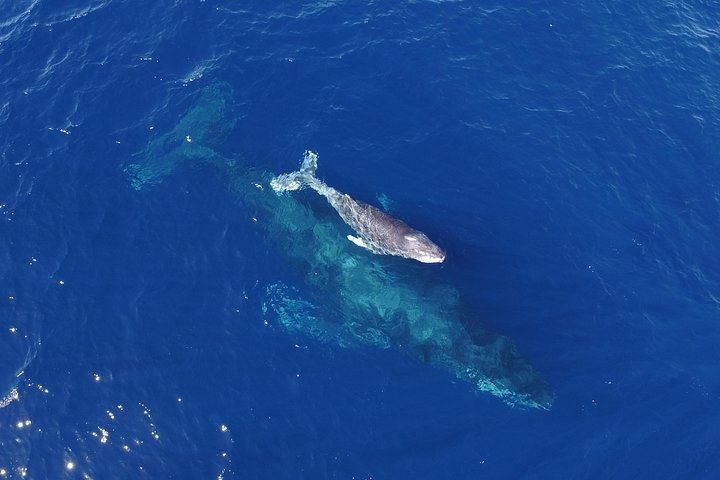
- Mothers and calves: newborns arrive at about 13 to 16 feet after an 11-month gestation and stay alongside for up to a year, with a female producing one calf every two to three years on average
The humpback trip from the marina
If the humpback is the species you came for, this 2.5-hour departure from $99, rated 4.9 ★ (1065 reviews), goes out with a marine biologist guide, bottled water and marine park fees included. You meet at the office inside the Tesoro Hotel at the Cabo San Lucas marina.
★ 4.9/5 · 1,065 reviews
The other species you might see besides humpbacks
Gray whales are the other species you have a real chance of seeing. The tourism board's season page has grays and humpbacks both working the coast with their young from December through April. Look for mottled gray skin with pale barnacle patches, no dorsal fin but a row of knuckles running along the back toward the tail, and a low blow that often looks like a double puff instead of one bushy column. Grays tend to keep travelling rather than settle, so expect a passing look. The lagoon encounters people picture, with animals coming up to the hull, happen on the Pacific side: that is a full day out of Cabo San Lucas with around five hours of driving each way, and the gray whale page on this site works through whether it is worth your day.
Blue whales sit in the rare group off Cabo San Lucas, alongside fin and orca. The blow is a tall narrow column rather than a bushy one, the back behind it is long and flat with a small dorsal set well back, and the flukes almost never come up. No official source points to a month when a blue whale is likely here, so plan around humpbacks and count a blue as luck.
Fin whales show a tall, straight blow, a sleek back with a sickle-shaped dorsal set far back, pale asymmetric markings on the right side of the lower jaw, and a fast travelling rhythm with no tail display. Orcas are the easiest call when they turn up: a tall black dorsal above a black and white body, and a group moving with purpose at the surface. The water formally set aside for orca observation is not at the cape but up the coast at El Sargento and La Ventana, and the orca page on this site covers what that means for a day trip.
What people mistake for whales out there
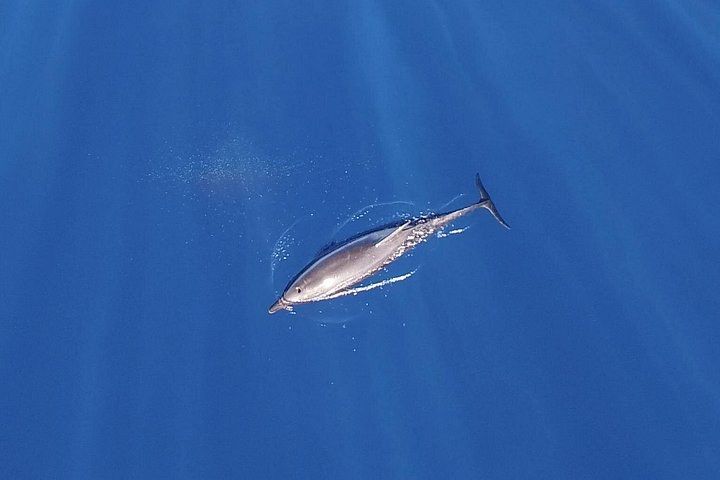
Dolphins account for most of the misidentifications on a Cabo trip. They surface in groups, fast and repeatedly, and they throw no tall column of spray, which is the cue that separates them from a whale at a distance. Sea lions at the surface read as a dark back for a second, mobula rays jump clear of the water and land flat, and a turtle's head looks like something far bigger until you focus on it.
The whale shark is the other animal people file under whales, and it is a fish: a broad flat head, a spotted back just under the surface, and a tail sweeping side to side instead of up and down. It is also not a Cabo activity. Swimming with whales is illegal here, and in-water time with a whale shark happens at La Paz, which the whale shark page on this site deals with separately.
Which trip format gives the best look at each species
The hydrophone is the one piece of kit worth asking about, because Mexican rules let a crew switch the engine off only while one is in use. Otherwise the engine stays running in neutral when the whale is still, and a male humpback's song never reaches you. Singers hold more or less one position while they perform, so you need a boat that can go quiet over a stationary animal to hear anything.
Distance is set by NOM-131-SEMARNAT-2010, and it decides how much detail you can resolve. For a humpback the floor is 60 metres if the hull measures under 10 metres and 80 metres for anything medium or large, which in Los Cabos leaves a permitted boat somewhere around 60 to 80 metres from the animal you are trying to identify, depending on its size. Four boats at most may stay with the same whale or group, observation ends at 30 minutes, boats waiting their turn hold 240 metres, speed stays under 5 knots inside the area and about 2 knots on entry, and a travelling whale is approached only on a diagonal from the rear quarter, parallel to its course. No boat may put itself between a mother and calf, or go near whales that are mating or calving.
- Humpback song: a boat carrying a hydrophone, since that is the only legal reason for the engine to stop
- Mothers with calves: a smaller hull, which works from 60 metres where medium and large vessels are held to 80
- Gray whales moving along the coast: flat water helps more than horsepower, and the official tourism board's advice is that early departures bring calmer seas and softer light
- Photographs: take the late slot for the light, and get the camera onto Shutter Priority at 1/1000 second with ISO on Auto and a high burst rate while you are still at the dock, with the sun over your shoulder so a mottled gray back or a raised fluke reads in the frame
- Orcas or whale sharks: a separate day and a separate stretch of coast, not an add-on to a 2 or 2.5 hour departure from the cape
What to check before you board
Every whale species in Mexican waters carries at-risk status, so the activity runs on authorization rather than goodwill. No company can take you out to any of them without first holding a SEMARNAT authorization for non-extractive use of wildlife, and the vessel it puts you on has to display an official identifying marker where passengers can see it. That marker is a flag: SEMARNAT hands each authorized company a fresh one for the season, numbered in the bottom right corner for the year, and it stays flying for as long as the boat is watching whales.
- This season's numbered flag flying, and a SEMARNAT authorization behind it
- A passenger briefing before departure, with the rules shown on visible signage, both of which are legal requirements
- No fishing, diving, swimming, water-skiing or parasailing while whales are being observed, and no sonar or echo sounders used to find them
- No whale watching from jet skis, kayaks, canoes or paddle-powered inflatables
Questions people ask
Are there blue whales off Cabo San Lucas?
Blue whales are recorded in these waters, but the tourism board puts blue, fin and orca sightings far below humpback and gray. No month makes one likely, and sonar or echo sounders may not be used to locate whales, so a sighting depends on eyes reading the surface. Plan the trip around humpbacks and treat a blue whale as a bonus.
Can you see orcas from Cabo San Lucas?
Orca sightings at the cape are rare. The observation area set aside for orcas is up the coast at El Sargento and La Ventana, covering 110,906.06 hectares and extending 10 nautical miles beyond Isla Cerralvo. Baja California Sur became the first Mexican state to legalize swimming with orcas, only at La Ventana, under a pilot scheme with boats capped at 24 a day, and getting there is at least a six-hour commitment from Los Cabos.
Do you have to reach the Pacific lagoons to see a gray whale?
No. The official tourism board describes gray and humpback whales both appearing along the Los Cabos coast with their young from December through April, so a gray whale is a legitimate sighting from a local boat. What the lagoons add is eye-level proximity, and the cost is a full day out of Cabo San Lucas with roughly five hours of driving each way for a few hours on the water. A local departure of 2 to 2.5 hours puts you on different water with different animals.
Which of these whales actually sing, and will you hear it?
The song belongs to male humpbacks, and a complete one lasts 7 to 30 minutes, with the repertoire changing from year to year. You will hear it only if the boat carries a hydrophone, because Mexican rules allow the engine to be switched off for that purpose alone. A singer tends to stay in one place throughout the display, so a quiet boat over a stationary whale is the combination to book.
Read also